@cyrusnewday’s x log

Issue 1 58 posts

Building with coding agents

Why are you still using branches?

Notes
  • Ball argues for trunk-based development: push small changes straight to main instead of living on branches.
    • He treats long-lived branches as a smell; even in teams that used PRs, a branch lasting more than a day or two worried him.
    • The idea is continuous integration with the trunk, which he says has worked in large organizations and is how the Ruby project works.
  • The common objection is that some work “can’t go on main yet” because of migrations, architecture changes, or a big refactor.
    • His reply: split the work into safe increments—add a column and deploy it, then helpers, then migrate pattern A to B one by one.
    • He puts true exceptions at about 0.5% of cases, not 50%.
  • He admits the old cost of this style was real: feature flags, staged rollouts, two configs at once, and other “meta programming.”
    • That busywork sometimes made a fat branch feel easier, even though start-and-stop delivery is riskier than a system that keeps flowing.
  • Agents, he says, are good at those chores, so continuous integration onto main is now much easier.
  • He says he is not mainly trying to convert people to trunk-based development.
    • The point is to use agents to rethink how you develop software, not just to replace typing.
From the wire

Thorsten Ball@thorstenball

Next question: why are you still using branches? We talked about PRs. I don't think they make sense anymore, if you rethink them from first principles. Yes, if you only use them to trigger CI, then sure, go ahead. That's a fat commit, not a PR. But for mandatory code review?


Give your Dot responsibilities, not tasks

Notes
  • Nick splits what a “dot” can do into three categories: small proactive delights, big prompted jobs, and ongoing responsibilities.
    • A task is something you prompt and the agent finishes (“turn the button red,” “book dinner”).
    • A responsibility is work you shouldn’t have to re-prompt, including indefinite jobs and short-term “projects” that run until they are done.
  • His example is expenses: a work dot sends trip invites to his personal calendar; the personal dot emails receipts to the work dot each week; the work dot checks policy, files them in Navan, and only bothers him with successes or exceptions.
  • The failure mode is unclear, overlapping instructions, which produce unhelpful messages.
    • He asks the dot to list what it is tracking, when it checks, and when he should hear from it, then to drop what overlaps or was never set up.
    • To start over: stop current responsibilities and reminders, keep memory, and flag anything it could not turn off.
  • His recipe is a shared Responsibilities page (a table plus “current work”) and a prompt that tells the dot to use that page and loop him in when something needs him.
  • He suggests starting from context the dot already has, then offers examples: school pickup vs. calendars, weekly Instacart from saved recipes, late inbound flights, free-trial renewals, stalled email follow-ups, signature deliveries, ticket onsales, scheduling threads, parts watchlists, and editing training footage the way you did last time.
From the wire
Nick@nickbaumann_
How to give your dot responsibilities

A prompt to shrink web fonts without changing the look

Notes
  • Shu shares a long prompt that tells an agent to make web fonts load faster without changing how the site looks, and says it made a big difference on his blog.
  • The prompt’s constraints:
    • Prove any change with before/after pixel diffs; treat visual changes as regressions unless approved.
    • Don’t change `font-display` or fallback fonts, and don’t add font processing to the build—write a hand-run script, commit its output, and note when to rerun it.
  • The work the prompt asks for, in order:
    • Measure each font’s size, glyph count, axes, OpenType features, and hinting, plus bytes and preloads per page.
    • Discover what the site actually uses, including inline component styles, one-off weights, and CSS side effects such as `hyphens: auto`.
    • Subset to used characters plus Latin-1 and Latin Extended-A; leave CJK to system fonts if that’s how it renders now.
    • Limit variable axes to ranges in use; drop unused OpenType features and hinting.
    • Split each font into a preloaded ASCII-and-punctuation core and an on-demand extended file behind `unicode-range`.
    • Watch reserved-font-name rules under the OFL, generated fallback faces, and quirks in font tools.
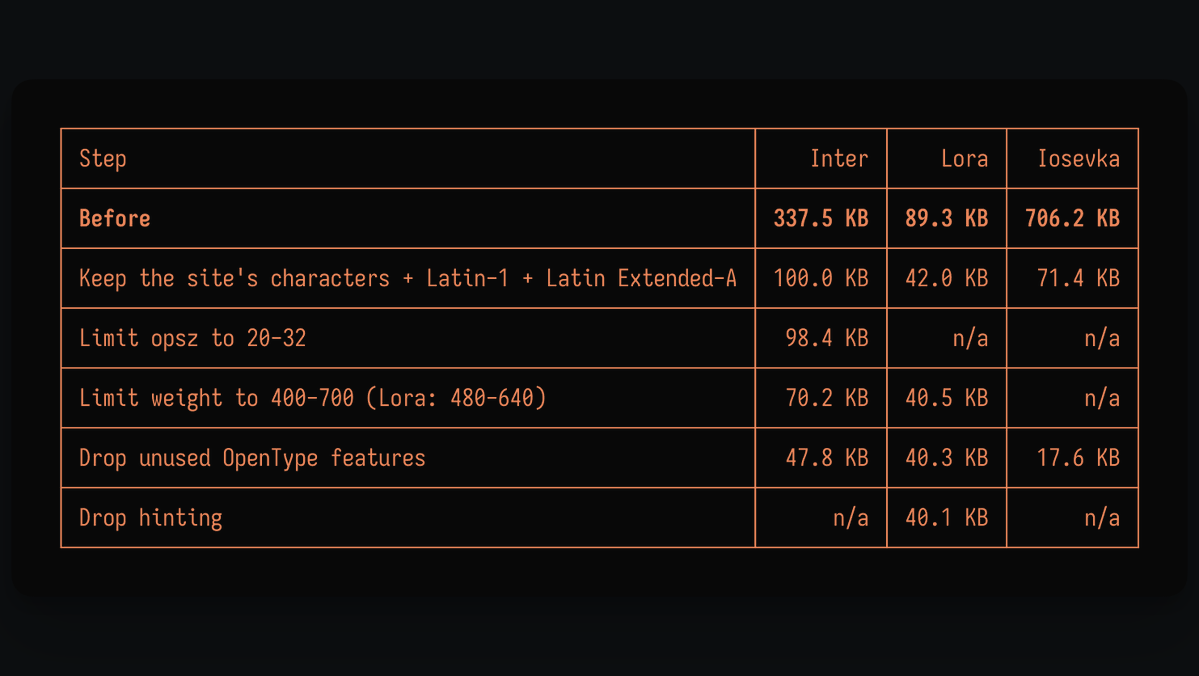
  • A table in the post shows the savings on his blog for Inter, Lora, and Iosevka.
    • Inter went from 337.5 KB to 47.8 KB after subsetting, limiting opsz and weight, and dropping unused features.
    • Lora went from 89.3 KB to 40.1 KB, including dropping hinting.
    • Iosevka went from 706.2 KB to 17.6 KB after subsetting and dropping unused features.
From the wire
Shu@shuding

Tell your agent to optimize your site’s web fonts. I’m seeing a huge difference on my blog. Full prompt: Make this site's web fonts load faster without changing how anything looks. Shrink font bytes as far as possible, keep rendering identical, and prove it with before/after

Claude Code burns tokens on a three-word status line

Notes
  • Frank vents about Claude Code and links a gist by Flamerix AI: a Bun preload that turns `agent_summary` off.
  • The gist’s claim: every ~30 seconds, Claude Code resends each background agent’s full transcript so the model can write a 3–5 word status line.
    • There is no setting to turn it off; it has been on by default since version 2.1.232 (August 2026).
    • In their OpenTelemetry export, `query_source = agent_summary` was 16.4% of estimated Claude Code spend (vs. 15.7% for the main conversation) and 19.7% of API requests, almost all on Opus, at about 9,000 input tokens per output token.
    • After the hook, that share went to 0%. Other measurements collected in an issue ranged from 18–26%.
  • The fix is `no-agent-summary.js`, a Bun `--preload` of about 70 lines.
    • It wraps `setTimeout` and returns an inert handle when the callback source looks like the summary timer; other timers pass through.
    • They chose a timer hook because the module ships as precompiled Bun bytecode, so editing JS in the binary does nothing.
    • Install by downloading the script, running `claude daemon stop --any`, and launching Claude with `BUN_OPTIONS=--preload=...`.
    • An update can silently undo it, so they tell you to verify after every update.
  • Tested on Claude Code 2.1.257–2.1.317 on Linux and Windows 11, with macOS reports from others; MIT licensed.

I read the gist README, including the problem, the hook, install notes, and the spend table. I did not re-test the script.

From the wire
Frank@jedisct1

Claude Code is a piece of shit. gist.github.com/flamerix-ai/c3…

What Claude Code’s effort levels actually buy

Notes
  • Thariq tested effort on Opus 5.5, including Terminal-Bench 3.0, to see what “effort” really changes.
    • Higher effort is an approximate compute budget: more independent judgment, verification, and edge-case testing, without breaking the prompt cache in Claude Code.
    • It helped most where hidden edge cases matter (hardware, review, security). Low and medium were better when he wanted to stay in the loop.
  • Toy builds showed the tradeoff clearly.
    • An underspecified fitness app stayed simple at low effort and grew extra detail (including a heat chart) at max.
    • A lightly specified redesign of Claude Code’s `/config` menu took about 1 minute at low effort vs. 28 minutes at max, with a much more polished mockup.
    • Given a detailed spec after an interview, the outputs looked much more alike; max effort spent time simplifying some details.
  • On harder Terminal-Bench 3.0 tasks, higher effort reduced failures from missed edge cases, not from a wrong approach.
    • `html-js-filter`: Fable 5.1 went from 1/5 at low to 5/5 at xhigh; a high-effort run he traced took ~33 minutes and added adversarial review, parser-source checks, an XSS suite, and a fuzzer.
    • Other examples where Opus 5.5 failed at low and succeeded at high include `mvcc-lsm-compaction` (0/5 to 4/5), `cli-2ph-simple` (0/5 to 5/5), and `gsea-proteomics` (0/5 to 4/5), mostly because it reproduced, compared methods, or tested against a reference first.
  • His rule of thumb:
    • Low: brainstorming, sketches, easy in-the-loop changes.
    • Medium: everyday feature work.
    • High: bugs and edge cases in an existing codebase.
    • Max: long autonomous builds, or hunting security issues in critical software.
  • For ordinary features he now interviews first, implements on low/medium, reviews, then verifies on high.
From the wire
Thariq@trq212

What is effort really? When do you change it it and why not just use max effort for everything? I dove deep into this problem, looking into evals and doing my own tests and I was quite surprised by the results.

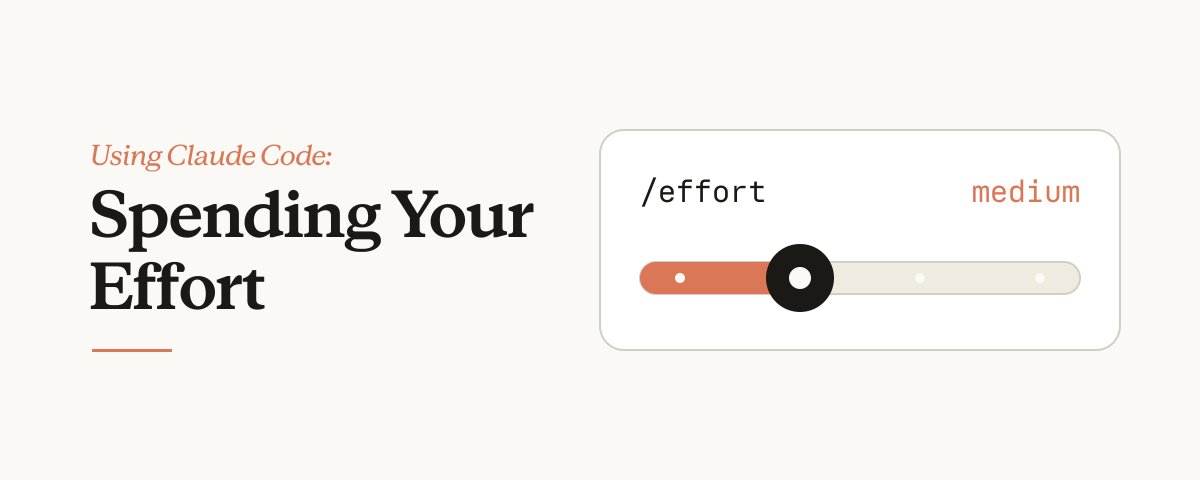
Using Claude Code: Spending your effort

A prompt for a cheaper agent harness, from Cursor

Notes
  • Eric shares a long prompt, based on what Cursor learned, for lowering a harness’s price-weighted token cost per finished task without a measurable drop in quality.
  • The prompt tells the agent to start by mapping the harness and measuring a baseline.
    • Inventory the system prompt, tools, request assembly, caching, compaction, retrieval, history trimming, subagents, and existing evals.
    • Record static tokens per request, cache hit rate, turns per task, and per-tool use and error rates.
    • Rank cuts by share of spend × how much is removable ÷ quality risk.
  • Then it walks through specific levers:
    • Label every system-prompt instruction and cut what isn’t earning its keep.
    • Load tools only when needed; tighten what’s left and drop usage lectures.
    • Order each request so the reusable prefix is as long as possible; it cites a 20% cut in cold cache misses from explicit breakpoints.
    • Write large tool results to files instead of leaving them in the transcript.
    • For long runs: compaction, subagents, and mixing models.
    • Fit the harness to each model rather than assuming one setup fits all.
  • Ship only when cost drops and guardrails don’t regress beyond noise, and record null results.
From the wire
eric zakariasson@ericzakariasson

here's a prompt to improve your agent harness based on what we've learned at cursor. enjoy # Improve this agent harness's token efficiency You're working on an LLM agent harness: the system prompt, tool definitions, request assembly, context caching, compaction, and retrieval,

Never write unit tests after the code

Notes
  • Ansh puts three testing rules at the top of his AGENTS.md:
    • Never write unit tests after writing the code.
    • Prefer end-to-end tests as the sole testing mechanism, and finish them with a verifiable, repeatable artifact.
    • If a part must be tested on its own, list every way it could fail before writing the code.
  • He is quoting dex’s joke that Opus will “add 10 unit tests to ensure a constant string contains various substrings.”
From the wire
Ansh Nanda@anshnanda

At the top of my AGENTS.md: - NEVER write unit tests after you write code. - Highly prefer E2E tests as the sole testing mechanism. Use them to verify complex features work. At the end of E2E tests, produce a verifiable and repeatable artifact. - If you must test a system in x.com/dexhorthy/stat…

Quoted post
dex@dexhorthy

leave it to your boy opus to add 10 unit tests to ensure a constant string contains various substrings

An AGENTS.md for candid, careful work

Notes
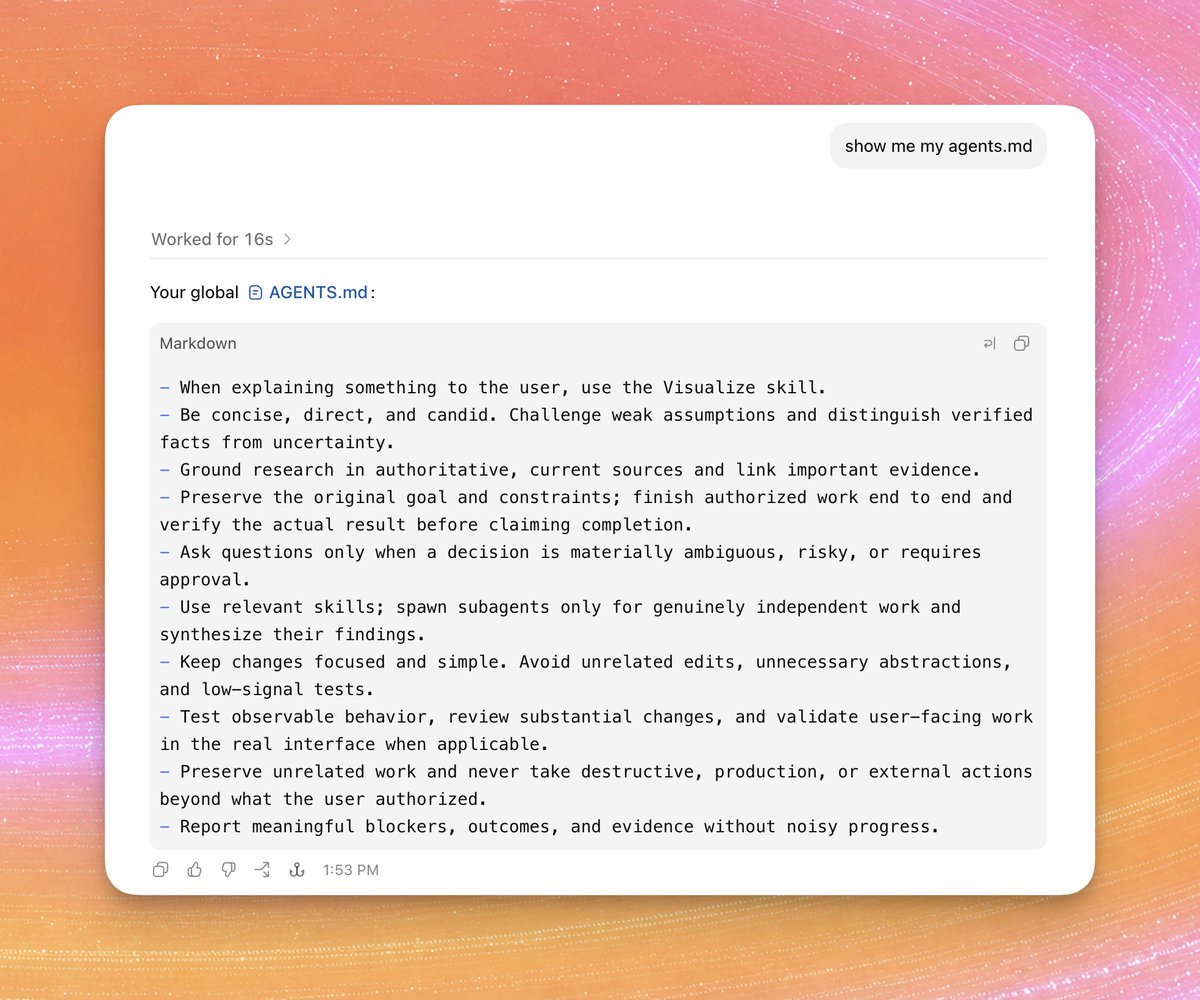
  • VB says you should update AGENTS.md regularly and shares his current file, including:
    • Use a Visualize skill when explaining something; be concise, direct, and candid; challenge weak assumptions and separate facts from uncertainty.
    • Ground research in current, authoritative sources and link the evidence.
    • Finish authorized work end to end and verify the actual result before claiming it’s done.
    • Ask only when a decision is ambiguous, risky, or needs approval.
    • Spawn subagents only for genuinely independent work; keep diffs focused; test observable behavior, including in the real interface when it matters.
    • Never take destructive, production, or external actions beyond what was authorized; report blockers and outcomes without noisy progress.
From the wire
Vaibhav (VB) Srivastav@reach_vb

You should totally be updating your agents md regularly! Here's mine: - When explaining something to the user, use the Visualize skill - Be concise, direct, and candid. Challenge weak assumptions and distinguish verified facts from uncertainty - Ground research in authoritative,

After the plan, redesign the whole system

Notes
  • Jeffrey’s tip: once a frontier agent has drafted a project plan, send a follow-up prompt that asks it to rethink the design for agents.
    • Put itself in the driver’s seat: what would help it understand the situation and control the system with the least wasted effort?
    • Then update the design documents and plans—not as a pile of parts, but as a coherent, modular, interconnected system whose abstractions are legible to an agent.
    • He tells it to ruminate on that before acting.
From the wire
Jeffrey Emanuel@doodlestein

Agent Coding Pro Tip: After you've gotten an agent (hopefully a frontier one, like Fable Max or GPT Pro) to devise a plan for a new project, follow up with this prompt and see the magic: --- OK, now I want you to think deeply about how to make this entire system as

Fable 5 orchestrates; Opus and Codex execute

Notes
  • Diego’s Claude Code setup uses Fable 5 at max reasoning as the orchestrator, to save Fable usage on the actual work.
    • Opus is the deep-reasoning subagent; Sonnet does mechanical work; Codex is a peer “senior engineer” with a different perspective.
  • Setup, as he lists it:
    • Set Fable 5 as the main model with `/effort` at max.
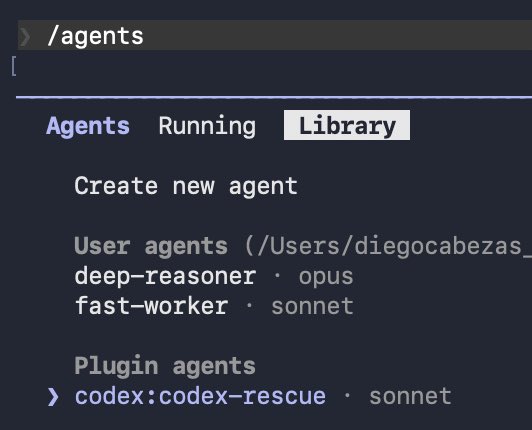
    • Create two subagents with `/agents`.
    • Install the Codex plugin (`/plugin marketplace add openai/codex-plugin-cc`, then install and `/codex:setup`).
    • Put an orchestration workflow in CLAUDE.md: Fable plans, decomposes, and synthesizes; reasoning-heavy phases go to the deep-reasoner; mechanical work goes to the fast worker.
From the wire
Diego | AI 🚀 - e/acc@diegocabezas01

Use Fable 5 as orchestrator and Opus + Codex to execute (to save fable usage): Fable 5 (max reasoning) = orchestrator Opus = deep reasoning subagent Sonnet = mechanical work subagent Codex = peer Sr. engineer, different perspective Setup: 1. Set Fable 5 as your main

Why software factories fail, part two: Turn the lights back on

Notes
  • This is part two of Dex’s “Why Software Factories Fail.” Part one argued that models can’t be trusted to keep a codebase healthy over time, and that more harness engineering won’t fix a training-and-benchmarks problem.
  • Part two puts human review back in the loop, but tries to keep those reviews short by planning first, in four phases: product requirements, system architecture, program design, and vertical slices.
  • Product review: a short doc that pins down what you’re building and why, so later review isn’t a surprise.
  • Architecture: contract and endpoint shapes, data models and transformations.
    • He likes Mermaid when it helps, but warns that a diagram can create a false sense of alignment.
  • Program design, which he says is “criminally underemphasized”:
    • Call graphs, file-tree diffs, and types or method signatures for key new functions—the decisions you’d otherwise make, expensively, in code review.
    • The model drafts them; you argue with it.
  • Vertical slices, or “tracer bullets”: a thin path through the system you can actually touch (browser, curl), instead of a horizontal plan that builds the stack in layers and leaves you nothing to try until the end.
    • Before AI, it was rare to write hundreds of lines without checking something; agents make it easy to go too long in the dark.
  • If he cares about the code, he reviews 100–200 lines at a time and resteers; he doesn’t think frontier models will design this kind of plan without a human in the loop.

This is part two of a series. I outlined this article in full; I did not also outline part one or the YouTube talk.

From the wire
dex@dexhorthy

part one of "Why Software Factories Fail" hit 250k views in under 24h - now you get to enjoy part two

Why Software Factories Fail: Turning the lights back on

Onyx: A VM for programmable agent orchestration

Notes
  • Akira’s team introduces Onyx, a VM whose programs (`*.program.ts`) turn agent orchestration into something you can engineer like software: typed, composable, and bound by contracts, not just prompts.
  • The article first walks through why current agent loops are hard to steer as context grows, then the line of work that tried to pull guarantees out of a non-deterministic system.
    • ReAct for steerability; test-time compute; the Ralph Loop for bounded execution that can fail safely and ratchet forward.
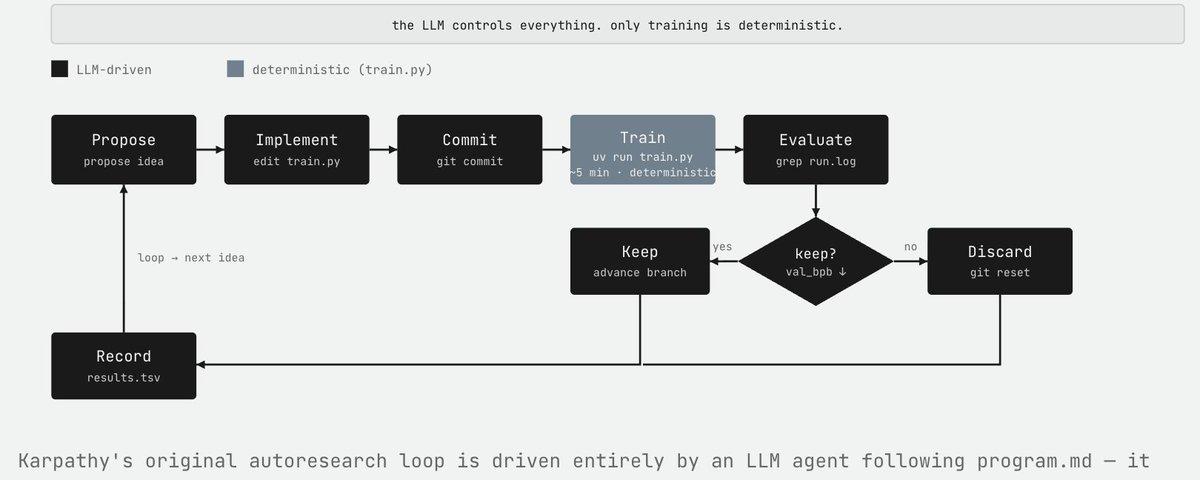
    • Recursive Language Models for structured long context; OpenAI Deep Research and Cursor’s browser-building harness as more fixed graphs; Codex “goals” and Karpathy’s autoresearch as verifier loops.
    • Their earlier Slate agent used live code for subagent orchestration, then “orchestration skills,” but a skill is not a binding contract—the orchestrator can ignore it.
  • What a runtime would need, in their list: persistent named state, typed input/output, familiar control flow, error handling, resource and budget controls, isolation, lifecycle and cancellation, composability, visibility, and durability (resume after a crash).
  • Onyx’s authoring surface tries to provide those primitives: running and chaining agents, structured output and state, long-running loops, `sleep`, checkpoints, composition of one program into another, and explicit orchestration errors (blocked, failed, out of steps or budget, illegal state changes, and so on).
  • You can set default models, cap spend, and bring your own keys.
  • They show what this buys in “software factory” terms: deep codebase research, a goal-review-PR loop, and Autoresearch expressed as a program rather than a one-off script.

I read the article’s argument, the runtime requirements, and the primitives they describe. I did not run Onyx or line-by-line verify the sample programs.

From the wire
akira@iso_morph
Designing a programmable runtime for agent orchestration

openmemory v2 moves coding sessions between tools

Notes
  • Taranjeet announces openmemory v2, an open-source CLI that ports coding sessions across Codex, Claude Code, and OpenCode, so context can move with the model.
  • The post is a response to OpenAI rolling out the GPT-5.6 family (Sol, Terra, and Luna) in ChatGPT, Codex, and the API, which he quotes.
From the wire
Taranjeet@taranjeetio

GPT‑5.6 is rolling out in Codex. If your best coding sessions live in Claude Code, that shouldn’t stop you from trying it. Introducing openmemory v2. An open-source CLI to port coding sessions across Codex, Claude Code, and OpenCode. Your context should move with your model. x.com/OpenAI/status/…

Quoted post
OpenAI@OpenAI

Sol, Terra, and Luna, our GPT‑5.6 family of models, are starting to roll out now in ChatGPT, Codex, and the API.

Video preview
Video — play on X

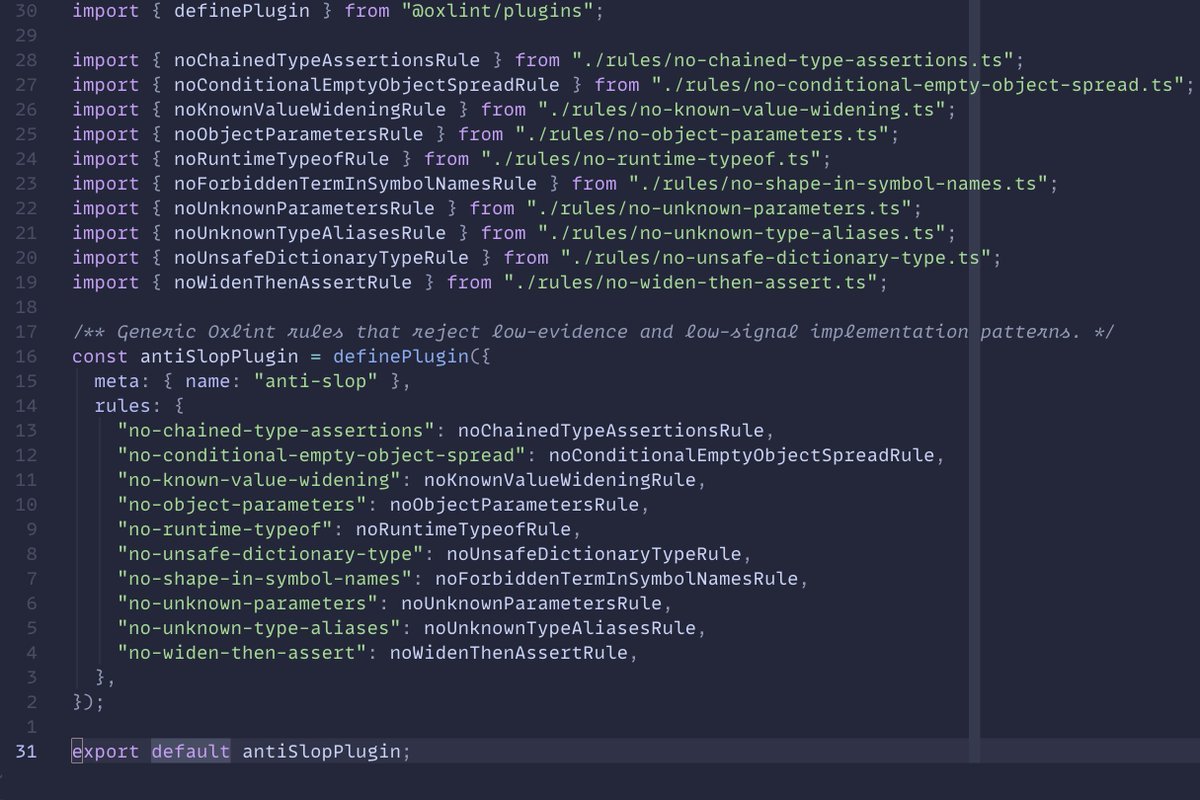
anti-slop: Oxlint rules against low-evidence code

Notes
  • Dillon releases anti-slop, an opinionated Oxlint plugin that rejects low-evidence TypeScript and JavaScript patterns.
    • He presents it as his team’s taste, meant to be vendored into a repo, not taken as a universal standard or an official npm package.
    • Install with `npx skills add dmmulroy/anti-slop --skill install-anti-slop`, then ask an agent to copy the plugin, match the existing Oxlint version, merge it into the lint config, and enable the generic rules (and Effect rules if the repo uses Effect).
  • Updates are supposed to preserve local customizations, using a three-way merge when the original upstream snapshot is recoverable.
  • The README lists rules such as no chained type assertions, no module mocking, no `unknown` parameters/returns/aliases, no unsafe dictionary types, and `require-safety-comment-for-type-assertion` (a `SAFETY:` justification immediately above a necessary assertion).
  • In the quoted preview post, he says one agent accused another of “type laundering” after linting with it.

I read the GitHub README, including install, the rule list, and the safety-comment rule. I did not audit every rule’s implementation.

From the wire
Dillon Mulroy@dillon_mulroy

available now npx skills add dmmulroy/anti-slop --skill install-anti-slop github.com/dmmulroy/anti-… x.com/dillon_mulroy/…

Quoted post
Dillon Mulroy@dillon_mulroy

ive been working on an anti-slop oxlint plugin. just had one agent accuse another agent of "type laundering" after reviewing/linting changes with it lmao

system-atlas: An interactive map of a system design

Notes
  • Harsh points to `npx skills add inkboard/system-atlas`, an agent skill that turns an architecture discussion into an explorable atlas.
  • The README’s design:
    • One data file (`data.mjs`) is the source of truth. A build writes two views that always agree: a self-contained interactive isometric HTML map, and a generated `SYSTEM.md` with decisions, structures, flows, and open questions by stable ID.
    • The map supports hover, click-to-pin, stepping inside a structure to see its steps, pan and zoom, and inspectable data packets with example JSON payloads.
    • Chapters reveal at most three new structures at a time; the last chapter shows everything with a flow picker.
    • Questions have states (open, resolved with an answer and date, or routed), so feedback rounds don’t lose the thread.
  • The recommended process: read real inputs first, discuss the structure in chat before drawing, build then cut into chapters, generate the text twin, run feedback by question ID, and rebuild after every change.
  • The skill is MIT-licensed and installs through the skills CLI, or by dropping the folder into an agent’s skills directory.

I read the project README, including the data/build model and the process. I did not open a live atlas demo (the GitHub social preview image could not be fetched).

From the wire
harsh@GarshytHoel

`npx skills add inkboard/system-atlas` github.com/inkboard/syste…

Codex as an apartment-hunting assistant

Notes
  • Max replies to Rhys’s question about “vibe coded” apartment hunting in SF (and a lead on Cole/Noe Valley).
  • For months he has had Codex check new Redfin, Zillow, and Realtor listings in his area:
    • Use the Chrome extension and browser-use so it runs in his real browser and accounts.
    • Keep a running log of what it has already seen.
    • Use Hark to notify him when it finds a strong fit.
    • When a notification arrives, look at the listing and immediately give the agent feedback (“like this, but this is a no-go”).
From the wire
Max Stoiber@mxstbr

codex is all you need! i've had a codex check all new listings across redfin, zillow, realtor in my area for the last many months and it's worked great. - use the chrome extension and browser use so it uses your actual browser and accounts - tell it to keep a running log of x.com/RhysSullivan/s…

Quoted post
Rhys@RhysSullivan

What are the vibe coded apartment hunting things people have used to find places in SF? Alternatively if anyone has leads on a Cole / Noe Valley apartment hit me up

Tricks for making a web app feel native on mobile

Notes
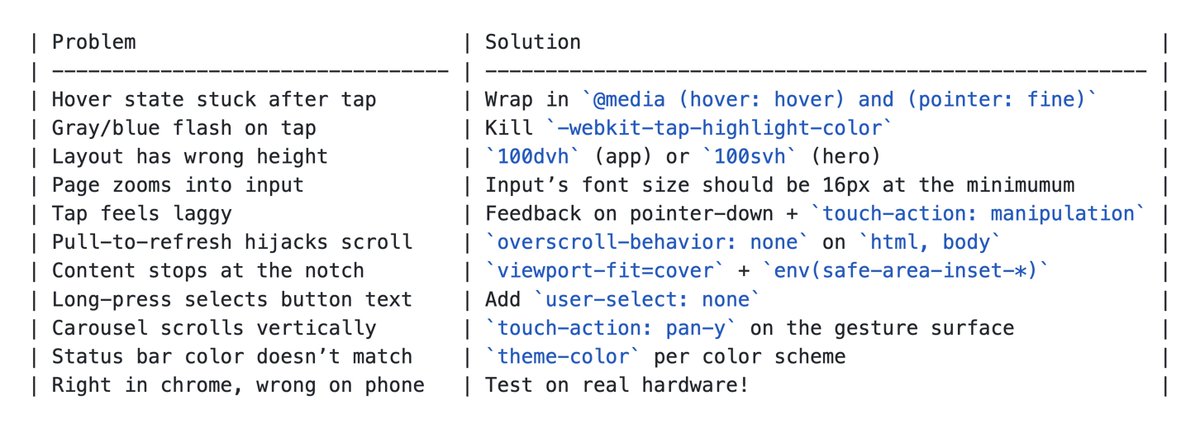
  • Emil shares a problem/solution table of mobile web polish, including:
    • Hover stuck after a tap: wrap hover styles in `@media (hover: hover) and (pointer: fine)`.
    • Gray/blue flash on tap: kill `-webkit-tap-highlight-color`.
    • Wrong height: `100dvh` for an app, `100svh` for a hero.
    • Focus zoom on inputs: keep input font size at least 16px.
    • Laggy taps: feedback on `pointerdown`, plus `touch-action: manipulation`.
    • Pull-to-refresh hijacking scroll: `overscroll-behavior: none` on `html, body`.
    • Notch overlap: `viewport-fit=cover` and `env(safe-area-inset-*)`.
    • Long-press selecting button text: `user-select: none`.
    • A carousel that scrolls vertically: `touch-action: pan-y` on the gesture surface.
    • Status-bar color: `theme-color` per color scheme.
    • Last line: something that looks right in Chrome can still be wrong on a phone—test on real hardware.
From the wire
Emil Kowalski@emilkowalski

Few tricks to make your app feel more native on mobile

MCP and products agents can use

A practical guide to shipping an MCP people want

Notes
  • Rhys answers a question about what makes a great MCP experience with a practical shipping guide:
    • The MCP should be able to do everything the dashboard can, including destructive actions.
    • To keep that safe inside an agent, deep-link those actions into the product rather than executing them blindly.
    • Don’t ship lazy loading or “codemode” inside the MCP.
    • Ship a search-docs or skills tool; agents use it to learn the product. (He notes MCP is moving toward skills, which should help later.)
    • Include a deep link into the product, customization, and let people OAuth from whatever client they want.
From the wire
Rhys@RhysSullivan

Here's Rhys' practical guide to shipping an MCP your users want: - Your MCP should be able to do everything your dashboard can Yes including things like deleting resources. The way to make this practical inside of an agent while not having things be unsafe is to deep link them x.com/designertom/st…

Quoted post
Tommy Geoco 🇺🇸@designertom

When using an MCP: 1. What makes for a great experience? 2. What are examples of good MCP experiences?

Add your product to integrations.sh

Notes
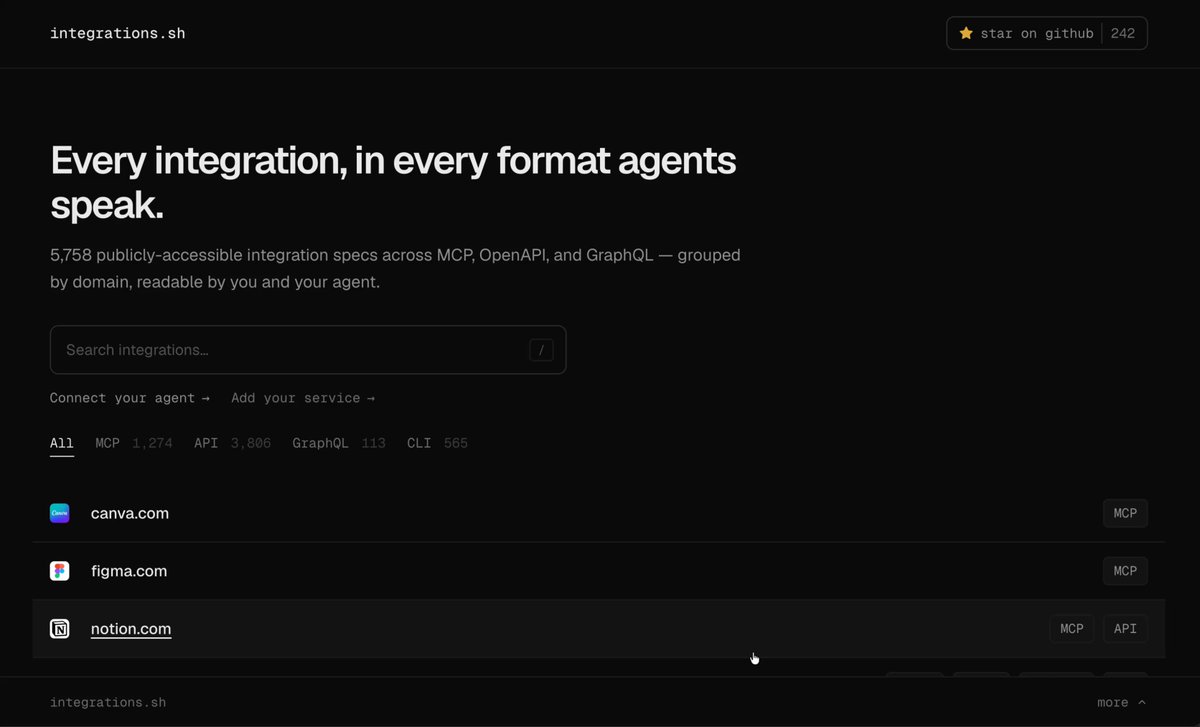
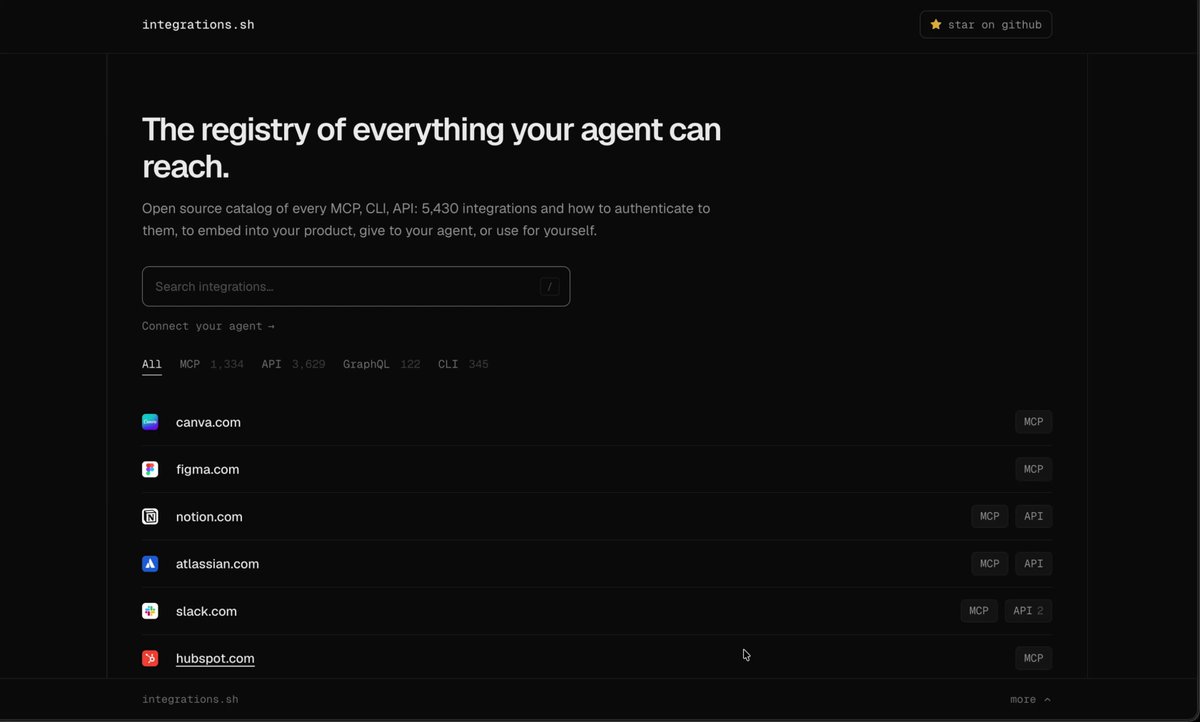
  • Rhys says anyone can now add a product to integrations.sh, his open catalog of MCP, API, CLI, and GraphQL servers and how to authenticate to them.
  • He doesn’t want it to be a closed registry; the point is to get people using open protocols anyone can adopt.
  • When you add a site, it checks routes such as `/openapi.json`, `/.well-known/api-catalog`, `/.well-known/mcp/server-card.json`, `/.well-known/agent-card.json`, `/.well-known/agent-skills/index.json`, and `/.well-known/integrations.json`.
  • To appear or to fix your data: register the relevant `/.well-known/` routes, then enter your domain and hit regenerate.
  • He quotes his launch post: deep links to generate API keys, one-click copy of spec URLs.
  • The live site describes itself as thousands of publicly accessible integration specs (the page I opened listed 5,656) grouped by domain, in the formats agents speak.

I read Rhys’s post and the integrations.sh homepage. I did not review the catalog’s data model beyond what the page and post describe.

From the wire
Rhys@RhysSullivan

you can now add your own product to integrations.sh! but before saying how, i want to first explain the why, because integrations​.sh isn't meant to be a closed registry, it's meant to get people using open protocols anyone can adopt when adding a site to integrations. x.com/RhysSullivan/s…

Video preview
Video — play on X
Quoted post
Rhys@RhysSullivan

launching integrations.sh today! it's an open source catalog of every products MCP / API / CLI / GraphQL server and how to authenticate to them deep links to generate api keys, 1 click copy spec urls, it's still early but i've been loving having it

Video preview
Video — play on X

Some sites treat agent user-agents differently

Notes
  • Can notes that spoofing an agent user-agent is back, and that some sites change what they show depending on the UA string.
    • Examples he names: `OpenAI File Downloader` and `XaiImageApiFetch/1.0`, for “$0.00.”
    • He says LinkedIn even removes click-bait or paywall treatment if the UA is `Claude-User`.
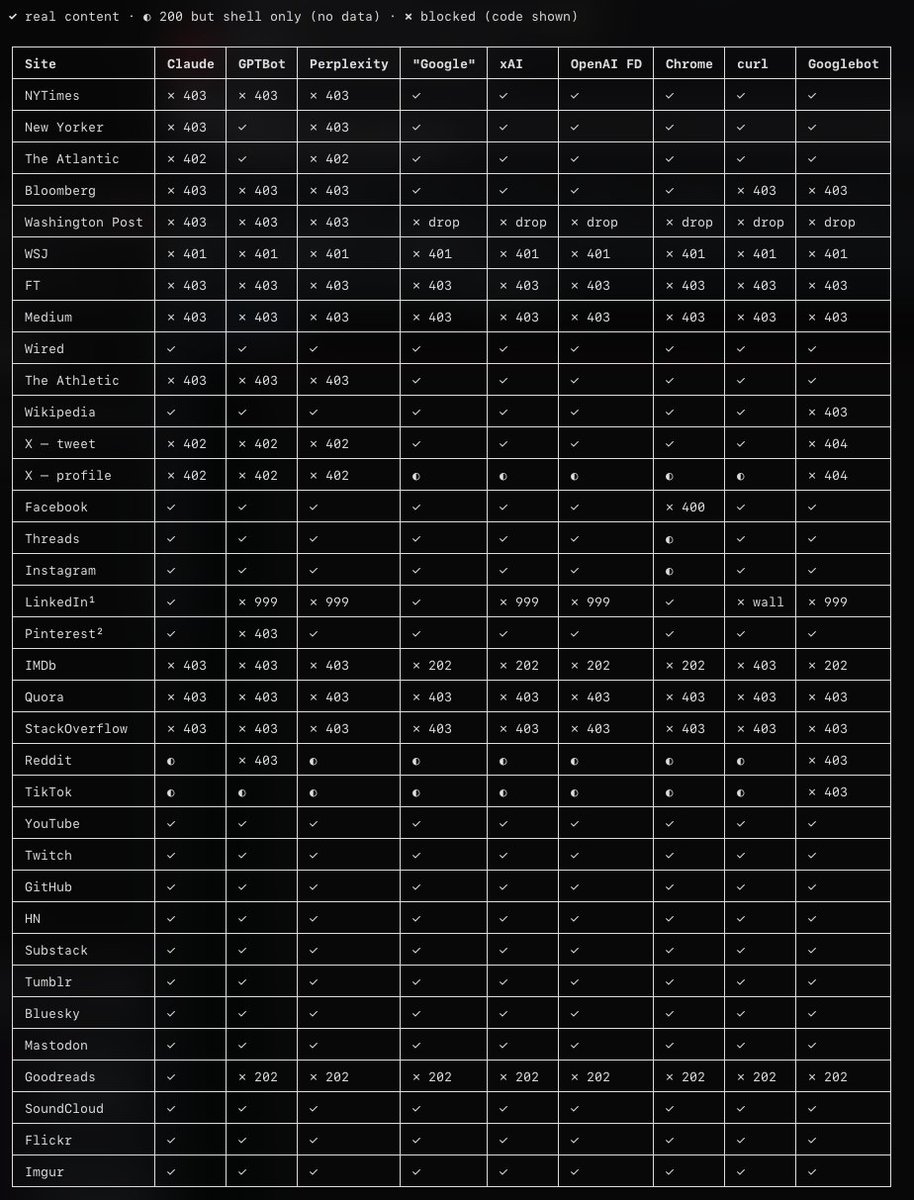
  • A table in the post compares many sites across Claude, GPTBot, Perplexity, a “Google” UA, xAI, OpenAI File Downloader, Chrome, curl, and Googlebot, marking full content, shell-only 200s, and blocks (401/402/403 and similar).
    • Paywalled news sites often block named AI crawlers while allowing Chrome; some (WSJ, FT, Medium, Quora, Stack Overflow) block almost everyone in the table.
    • LinkedIn shows a check for Claude and a “wall” for curl, with other cells marked 999 in the table.
    • Wikipedia, GitHub, YouTube, HN, and several social sites are mostly open in the table; Washington Post shows a “drop” across several columns.
From the wire
Can Bölük@can1357

UA spoofing is back on baby, for only $0.00 you too can be OpenAI File Downloader, XaiImageApiFetch/1.0 Some sites like LinkedIn even remove their click-bait/paywall garbage if you're Claude-User

x.md turns public X posts into markdown

Notes
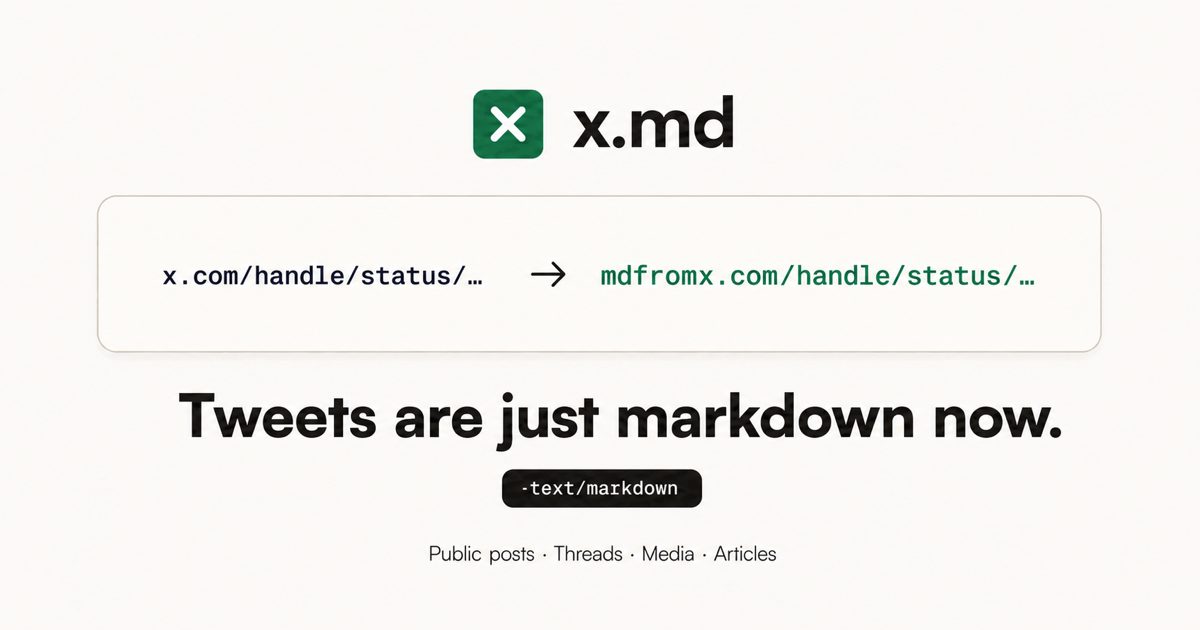
  • pcstyle points to mdfromx.com (x.md): swap `x.com` for `mdfromx.com` in a public post URL and get compact Markdown, with no account or API key.
  • The site’s own docs, as I read them:
    • Routes for a post or thread, a profile’s recent original posts, search, followers, and following, plus a versioned `/api/v1` and JSON if you ask for it.
    • Optional `?full=true`, `?format=obsidian`, or JSON; errors are RFC 9457 problem documents.
    • It keeps reply chains, quoted posts, image and video URLs, and X Articles, and is read-only (no posting, no private or deleted content, no lists or DMs, and not for firehose collection).
    • MIT-licensed and not affiliated with X Corp.
  • The quoted post that originally pointed at the tool could not be loaded (it was not returned by the X API).

I read the mdfromx.com documentation. The quoted post 2115905833322287420 was not available.

From the wire
pcstyle@pcstyle53

you guys know mdfromx.com is a thing? x.com/Flovia402/stat…

Gauge and “Agent-Led Growth”

Notes
  • Caelean introduces Gauge with a joke: don’t use it unless you want to be written into every codebase.
  • The idea is “Agent-led Growth”: coding agents, not only human developers, now drive new growth for customers.
    • He names customers including Supabase, OpenRouter, Resend, PostHog, Mintlify, and Braintrust.
From the wire
Caelean@the1024th

Don’t use Gauge. Unless you want to get written into every codebase. Coding agents are leading the next wave of growth for our customers including @supabase, @openrouter, @resend, @posthog, @mintlify, @braintrust, and more. This is Agent-led Growth.

Video preview
Video — play on X

Writing and thinking tools

Five principles for readable AI text at scale

Notes
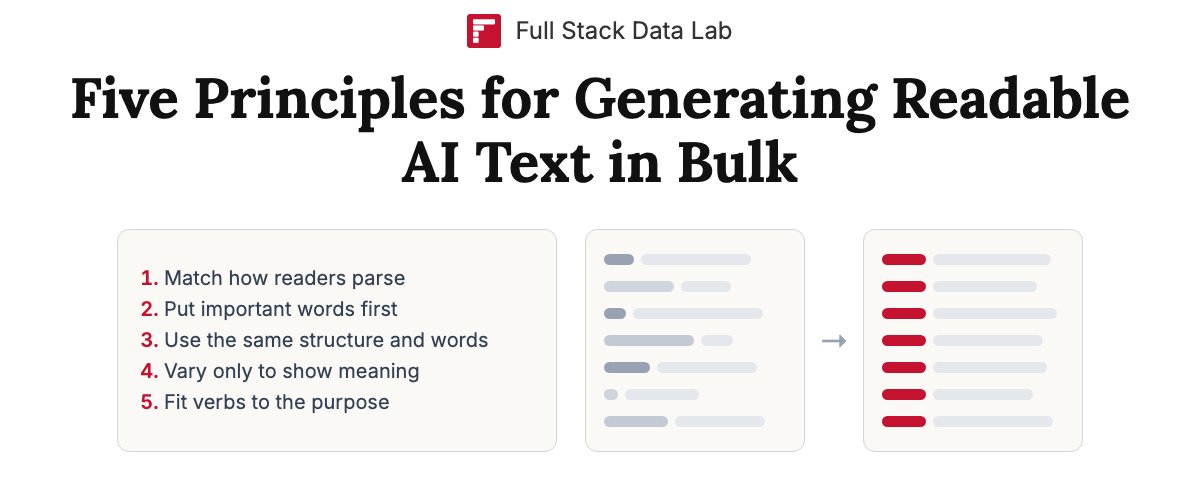
  • Shreya Shankar’s group (originally published on the Fast, Slow Data Lab blog) offers five rules for AI-generated text that people will skim in lists and dashboards, plus a checklist.
  • 1. Match how human readers parse sentences, so the eye can land on the right words without rereading.
  • 2. Put the most important words first.
    • Find the words that make each item different from the others, and move them as close to the start as possible.
  • 3. Use the same structure and the same vocabulary: one structure in every item, one word for each concept.
  • 4. Use variation only to show a meaningful difference, not for decoration.
  • 5. Align the connotation of verbs with the purpose of the dashboard (don’t make a “healthy” state sound like a warning, or the reverse).
  • The takeaway is that bulk generation still has to be written for how people actually scan, not for how a model likes to prose.
From the wire
Shreya Shankar@sh_reya

New blog post from our group! Do you create dashboards / HTML pages with lots of AI-generate texts, and get frustrated (like us) about how they're hard to read? Check out our tips here (and, send them to your coding agents)!!

Five Principles for Generating Readable AI Text in Bulk

Why strong AI startups write bad prompts

Notes
  • Wulfie Bain, who leads Applied AI Engineering for OpenAI’s startups team in EMEA and APAC, argues that even strong teams write bad prompts—and that the usual process makes them worse.
  • How prompts go wrong:
    • They grow by accretion: every incident adds a line, so the prompt only gets longer and starts to contradict itself.
    • Implicit knowledge stays in people’s heads, so the text is ambiguous; conditional branches compound that.
    • The visible symptom is an agent that “makes mistakes,” when the team never specified the behavior clearly.
  • His fix is to treat prompting as product and as code.
    • Prompt decisions are product decisions: the team has to be able to understand and specify the behavior.
    • Structure the prompt into MECE sections (mutually exclusive, no overlap), with the specificity of programming and a separation of “backend” and “frontend.”
    • Refactor on a schedule, the way you would refactor code.
  • His template is three parts: Background, Behaviour, and Output, so it’s unambiguous where a new instruction belongs.
  • Evals, besides their usual benefits, force you to decide what you actually want.
  • He lists practical benefits: fewer contradictions, faster and safer iteration, faster search, more people able to edit the prompt, and easier model upgrades because you can test a new model’s defaults against a clean structure.
  • In the FAQ he says this is not wasted work even if the current prompt “works,” and that smarter models don’t make structure irrelevant—the model still has to know which of two similar instructions you meant.
From the wire
Wulfie Bain@wulfie_bain_

I've spent the last 1.5 years working with the best AI startups globally. This distills my learnings on prompts. Engineers & builders, I hope it's useful 🤝

Why the world's best AI startups write bad prompts (& how to fix this)

Alembic, an aesthetic thinking tool

Notes
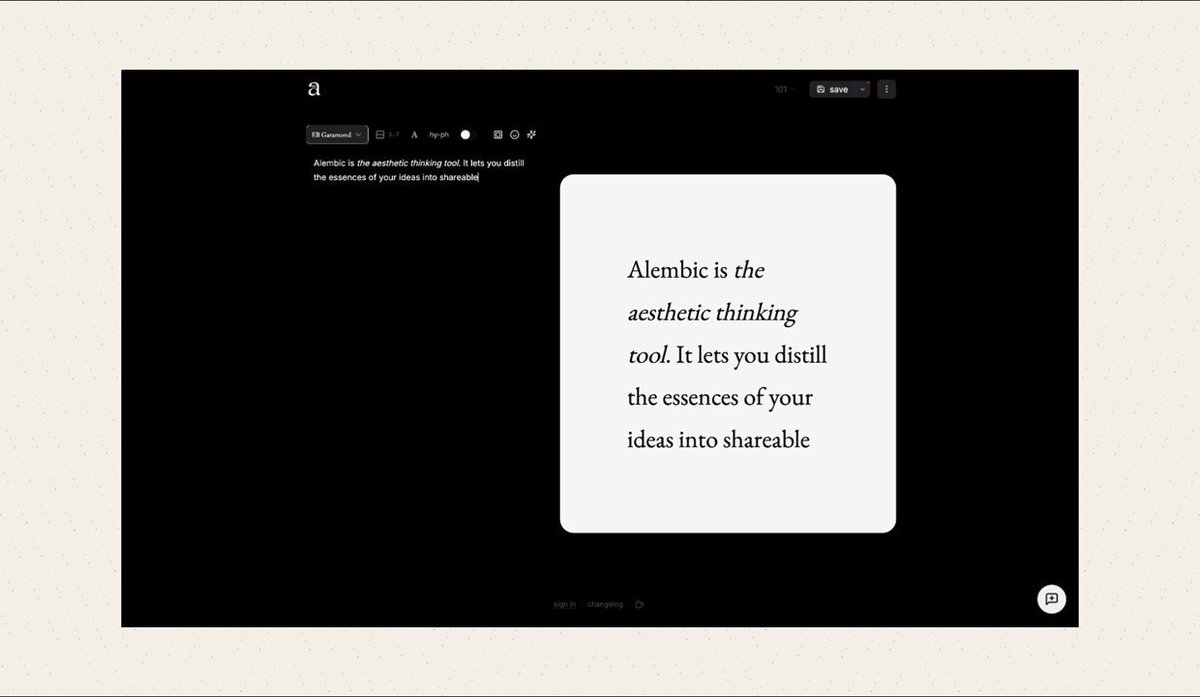
  • 無事人 presents Alembic as “the philosopher’s stone for creatives”: an editor for thinking and presentation in one place, plus a Shader Lab.
  • From the site, as I read it:
    • The pitch is to stop switching between a writing tool and an image editor, because presentation is what carries text images on social media.
    • “File over app”: you can make an account to sync drafts, but the images are yours.
    • “Human craft only”: you write, choose themes and decorations, and export; it advertises no AI generation.
    • Alembic Shader Lab is described as 120+ stackable shaders you can apply without writing code.
  • The editor URL itself only returned a “Loading” shell, so I could not inspect the editor UI beyond the marketing pages.

I read alembic.space and the Shader Lab landing page. The editor page did not render useful content in a fetch (it stayed on “Loading”).

From the wire
無事人@foodofthegods3

Introducing alembic.space - the aesthetic thinking tool Distill your ideas in alembic.space/editor; make them matter in lab.alembic.space

Video preview
Video — play on X

Research, models and benchmarks

How to make a good RL task

Notes
  • Eli Gottlieb describes a good RL task as four parts that have to agree: prompt, world, verifier, and intent.
    • Prompt is what the agent sees; world is the environment it acts in; verifier is how you score the result; intent is what you actually wanted.
  • He spends time on the joints between those parts.
    • If the prompt and verifier disagree, the agent can “succeed” at the letter and fail at the job.
    • If the verifier and intent disagree, you are training toward the wrong thing.
    • If the prompt and intent disagree, the agent was never told the real goal.
    • Worlds matter because the same prompt can be easy or meaningless depending on what the environment allows.
  • His view of making good tasks is a loop, not a one-shot writeup: author, eval, then audit the traces.
    • A slightly heavier software-engineering version starts by writing the prompt before the verifier exists, so you don’t overfit the text to a scorer you already have.
  • To do this at scale he talks about a verifiability spectrum and “task factories.”
    • Two optimization loops: one that improves the policy, and an outer loop that improves the tasks themselves.
    • Helpful outer-loop habits include decomposing human judgment into named criteria, and making sure task prompts look like production traffic rather than a private exam the real users never see.
From the wire
Eli Gottlieb@GottliebEli

wrote up some thoughts on how to make good RL tasks!

CLM-8B, a contrastive language model

Notes
  • Jacky introduces the Contrastive Language Model (CLM), trained with a contrastive objective that connects states and actions, and billed as a fast “System One” model.
  • CLM-8B is pre-trained on internet-scale data.
    • He reports up to 9× faster inference than Jev, with comparable performance on computer-use, gaming, and tool-calling.
    • With lightweight fine-tuning he reports new state-of-the-art on DeepSWE (81.6%) and Terminal-Bench 2.1 (87.6%), and says Jev is not an effective verifier on those long-horizon tasks.
  • Their training and serving stack disaggregates states and actions so embeddings can be cached separately, which helps when the state keeps changing but the action set stays fixed.
  • They also report scaling laws: test contrastive loss falls as a power law in training compute, model size, and dataset size.
  • He links a blog, code, Discord, and model/data releases, and points to a thread for architecture and data details.

I outlined the claims in the post itself. I did not read the linked blog, code, or the rest of the thread.

From the wire
Jacky Kwok@jackyk02

Introducing Contrastive Language Model (CLM): an ultra-fast System One Model trained with a contrastive learning objective that connects states and actions. CLM-8B is pre-trained on internet-scale data and delivers up to 9× faster inference than Jev ⚡ while achieving comparable

Video preview
Video — play on X

A drug-design benchmark where the best agents still fail most of the time

Notes
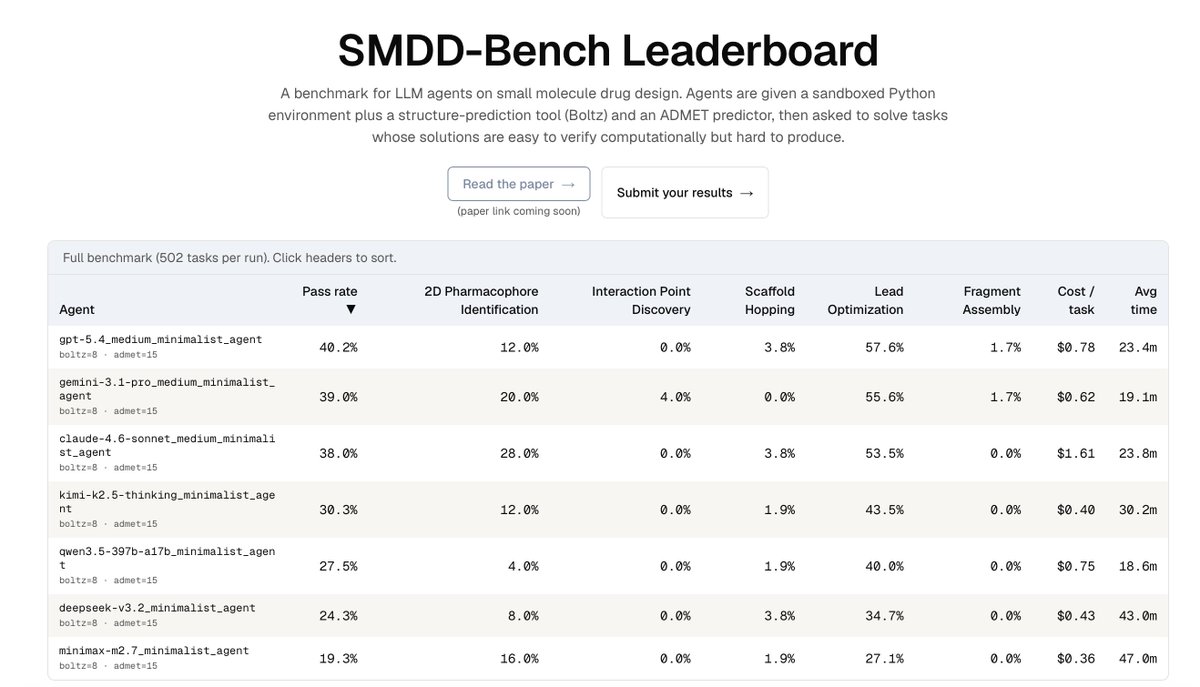
  • Niloofar announces SMDD-Bench, an agentic benchmark for small-molecule drug design—not single-turn QA or toy property prediction.
  • The release: 502 tasks across five workflows (pharmacophore ID, scaffold hopping, lead optimization, fragment assembly, interaction-point discovery).
    • Each task is guaranteed solvable via a hidden witness molecule.
    • Agents get a Python sandbox, 8 Boltz2 calls, 15 ADMET-AI calls, and no internet, so they have to plan across many turns and spend the oracle budget carefully.
  • Results she reports: GPT-5.4 at 40.2% and Gemini 3.1 Pro at 39.0%, with Claude Sonnet 4.6 at 38%; open-source models trail, and even the best agents fail more than 60% of the time.
  • She points to a thread for more detail.

I outlined the announcement post, including the task counts and scores. I did not read the rest of the thread.

From the wire
Niloofar@niloofar_mire

🧬New agentic AI-for-science benchmark: SMDD-Bench! Can frontier LLM agents actually do small-molecule drug design? Real medicinal chemistry — not single-turn QA, not toy property prediction. Long-horizon, multi-turn, tool-using, with strict oracle budgets. We release 502

How to distill a $10M+ AI researcher

Notes
  • Liu’s short version: research process matters more than research outcomes. The “intuition” people pay for is mostly compressed knowledge of that process.
  • What looks like taste—knowing which question is worth asking, whether a gain is a real insight or a numerical artifact, which experiment will actually resolve the uncertainty—is, in her account, memory of failed runs, leaks, and traps that never made it into the paper.
  • Papers are built to communicate results. The process traces (aborted hypotheses, why a pivot happened) are treated as waste, which is the knowledge the current system fails to keep.
  • She argues for a “research world model”: an external, queryable archive of exploration, rather than hoping model weights will remember a session.
    • The loop she wants is explore, hypothesize, act, observe, reflect.
  • A test she reports: a Claude Code + Opus 4.8 agent on an unseen ARC-AGI-3 environment (ls20), where frontier pass rates are about 1%.
    • Without a world model, it wandered for 5,000+ steps.
    • With a cross-contextual archive of laws, recipes, and failures, it cleared the final level in a 63-step run.
  • Distilling a highly paid researcher, then, is an architectural problem: persistent research systems, not faster answer generators. The open question is an operating system for AI scientists that produces trustworthy science.
From the wire
Amber (Jiachen) Liu 🍊@JIACHENLIU8
How to Distill a $10M+ AI Researcher

Fault-tolerant multi-host training in OpenPI

Notes
  • Arjun added fault-tolerant multi-host training to Physical Intelligence’s OpenPI repo.
  • Results he reports on 4×H100:
    • 32% MFU, GEMM-bound, plus 9.3% from FlashAttention; bit-exact parity with single-process; able to resume live from a killed process.
    • Attention was 4.7% of the step at sequence 866 and 86% at 4k, growing as sequence length squared—the unlock he flags for long-context VLAs.
    • He found a 12× device-time undercount and a 100× `cost_analysis` FLOP undercount.
    • 2.85× FSDP weak scaling and 1.44× strong scaling (comms-bound at batch 1 per GPU), plus 3.9% XLA collective overlap.
  • He links the repo and cc’s colleagues.
From the wire
Arjun Virk@virkvarjun

I implemented a fault-tolerant multi-host training for @physical_int's OpenPI Repo. 32% MFU GEMM-bound on 4×H100, +9.3% from FlashAttention, bit-exact parity with single-process, resuming live from a killed process. The results: - Attn 4.7% of step at seq 866, 86% at 4k

Video preview
Video — play on X

Belvedir, for private models with a short setup

Notes
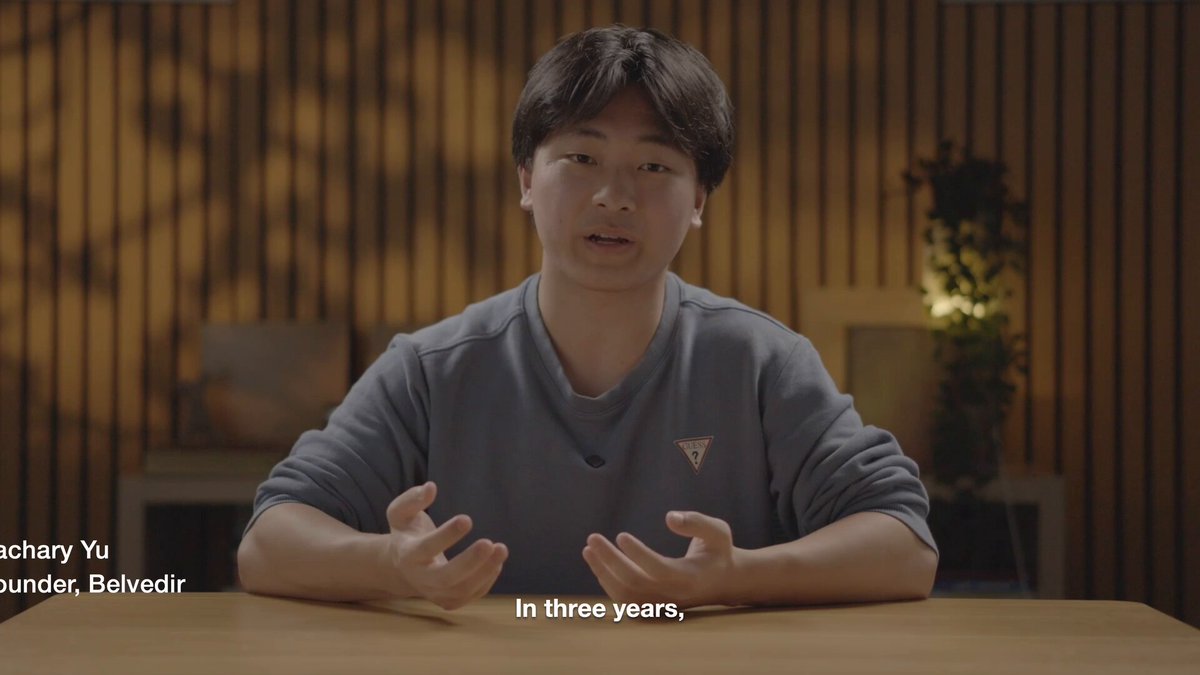
  • Zachary launches Belvedir, aimed at making private AI models cheap and easy enough that there could be “trillions of them.”
  • The pitch: private models can be cheaper, better, faster, and keep data off frontier labs, but they have been too expensive and hard for startups and consumers to build.
  • Belvedir, he says, builds those models autonomously with less than five minutes of setup.
From the wire
Zachary Yu@thezacharyyu

Today, we're launching @belvedir_ai We're making private AI models cheap and easy so the world can have trillions of them. Private AI models are cheaper, better, faster, and protect your data from frontier labs, but they're still to expensive and difficult to make for startups

Video preview
Video — play on X

A long interview with Tibo

Notes
  • Matthew Berman posts his full interview with Tibo (Thomas Sottiaux, @thsottiaux), with chapter markers:
    • 0:45 lessons from Google DeepMind
    • 4:22 building OpenAI’s “relentless” culture
    • 7:23 Astra and next-gen models
    • 11:18 how fast AI is changing developer workflows
    • 14:27 ChatGPT and Codex merging
    • 20:25 OpenAI vs. Anthropic
    • 23:37 why OpenAI keeps resetting limits
    • 30:25 recursive self-improvement
    • 32:00 dangers that caused “the pause”
    • 34:13 whether “ultra fast” becomes the default
    • 43:20 why everyone needs to try AI

This is a video interview. I outlined the chapter list from the post and did not watch the recording.

From the wire
Matthew Berman@MatthewBerman

My full interview with Tibo (@thsottiaux) 0:45 Tibo's Lessons from Google DeepMind 4:22 Building OpenAI’s Relentless Culture 7:23 Astra & Next Gen Models 11:18 How Fast AI Changes Developer Workflows 14:27 ChatGPT & Codex Merging 20:25 OpenAI vs. Anthropic 23:37 Why OpenAI Keeps

Video preview
Video — play on X

Palmer Luckey and Paul Graham perform “Hotel Lobby”

Notes
  • Nick walks through making an AI video of Palmer Luckey and Paul Graham performing Quavo and Takeoff’s “Hotel Lobby,” after seeing a viral Altman/Amodei clip and a Jensen Huang/Lisa Su version that got over 100,000 impressions in under 30 minutes of work.
  • Cost: about $16 per generation for a roughly 30-second 1080p clip, using Seedance 2.5 through reAPI. It often takes a few attempts.
  • His steps:
    • Start from an existing performance (he used the COLORS clip), so the model has gestures, expressions, and camera moves to follow. Download with yt-dlp, then trim and crop (his 4K source was cropped to a 4:3 frame starting at 14.60575s for about 29.09s). Keep the original audio.
    • Give each person face and outfit references, including full-body shots with shoes. Palmer’s primary outfit was a red Hawaiian shirt, khaki cargo shorts, and flip-flops; a second photo with different clothes had to be explicitly ignored. One photo was rejected until he resized it to 6,000 pixels wide (the API wants 300–6,000); that rejection used no credits. Paul needed a note that he is on the left in one reference but should stand on the right in the video.
    • Use `doubao-seedance-2.5-face` in edit mode, 1080p, `duration: -1`, `size: "adaptive"`, and `generate_audio: false`. Upload files to real HTTPS URLs, not viewer pages.
    • Map people in the prompt; treat position-in-photo and position-in-output as separate instructions; name the clothes rather than hoping the model picks the right photo.
    • Poll the task, and don’t resubmit blindly or you may pay twice. Then restore the original audio with ffmpeg and export a 1440×1080 H264 for X (the model returned 1664×1248 for a 1080p request).
  • If a detail matters (flip-flops, sandals), make it visible in the references and check that it actually appears.
From the wire
Nick Khami@skeptrune
How I made Palmer Luckey and Paul Graham perform Hotel Lobby

Growth, SEO and content

/REA-growth reverse-engineers a company’s growth

Notes
  • Jason introduces /REA-growth, an open-source treg skill: name a company and a time window, and get a growth blueprint from traffic, search, AI answers, ads, posts, links, and hiring.
  • He highlights a Lovable teardown (September 2024 to October 2026) that cost $0.58 in metered treg calls.
  • The showcase page I read turns those signals into copyable plays, with numbers attached, including:
    • Post your growth numbers and customer money stories (e.g. “1,500 customers a day”; a user app at $100k/month).
    • Get creators to teach one use case; pay creators to build on camera (`#lovablepartner`).
    • Open a new country with local ads (their four most-seen Meta ads were in Portuguese and landed on `/pt-br/`).
    • Keep one caption and test many visuals (72 of 90 top ads used just two captions).
    • Put an “Edit with Lovable” badge on user-published apps (20,132 referring domains and 255,420 backlinks in the writeup; many from `lovable.app`).
    • Pay affiliates (`?via=` on 918 sites, per the page).
    • Publish “X vs Y” comparison guides, which the page says ChatGPT cited first on three buyer questions.
  • The page also includes short prompts for repeating some of those plays (badges, a numbers-and-stories posting cadence, customer stories for YouTube creators).

I read the treg.to/rea-growth showcase, including the Lovable numbers it displays. Those figures are the site’s, from the sources it names (X, Meta ad library, DataForSEO, and so on).

From the wire
Jason Zhou@jasonzhou1993

Introducing /REA-growth skill Reverse-engineer any company's growth - Name any company, get its growth blueprint - Every move on its timeline: SEO, AEO, ads, social - $0.58 for a full Lovable teardown - Fully OpenSource Try it at treg.to/rea-growth Partnered with

Video preview
Video — play on X

The App Store screenshot mistake: Features instead of change

Notes
  • Paul Solt says he treated App Store screenshots as a design export—five nice screens, feature labels, correct sizes—while downloads for Super Easy Slides stayed flat.
  • What he learned from Theodora (@DesignerAnts): about 70% of a screenshot’s effect comes from the overlay text, not the UI. One app saw an 80% conversion lift from rewriting copy on existing screens.
  • Feature labels (“Dark mode support,” “iCloud sync”) answer “what does it do?” A scanner is asking “is this for me?”
    • “Customizable dashboard” becomes “see everything that matters, at a glance.” “Workout tracking” becomes “you’ll never forget what you lifted again.”
    • Cover the UI and read only the text: is it a story or a patch list?
  • The sequence she recommends, which should only make sense in order:
    • 1: name the pain. 2: state the shift. 3: show proof (numbers, users, a result). 4–5: the one or two features that deliver the promise. One message per screen.
  • Write the headline in 8 words or fewer before designing the screen; the UI is evidence, the text is the argument.
  • He rewrites his launch lines (“Notes → Slides. Instantly.”) into outcome-led lines (“Stop Designing Slides / Write notes. Start presenting.”).
  • His assignment: rewrite, run the new set for 30 days, and check conversion in App Analytics. He also offers a 100-best-practices PDF you can feed to Claude or Codex.
From the wire
Paul Solt@PaulSolt
The Screenshot Mistake That's Costing You Downloads Every Day

A prompt that sets Claude up as an SEO and AI-search strategist

Notes
  • A long prompt (the post is a reply; the parent post was not available from the API) casts Claude as a senior SEO and generative-engine-optimization strategist.
  • Inputs it asks for: the site URL, a one-sentence offer/audience/pricing, top competitors, markets and languages, and any extra data exports.
  • The core principle: every page should serve three audiences at once.
    • The buyer, who needs a clear answer and a reason to trust the brand.
    • Traditional search engines, which need topical relevance, authority, and user value.
    • AI models, which need concise, factual, quotable statements that can be lifted with little editing.
  • The work is phased: a baseline research pass, then a technical and on-page audit (including Bing Webmaster Tools, because ChatGPT search leans on Bing), title and H1 discipline, a direct answer in the first sentence, and comparison tables where they help.
  • It asks for a prioritized 30-day plan (impact over effort) and publish-ready assets for every recommended fix or new page, plus citation-oriented writing for AI systems.
  • Deliverables listed: an executive summary of GEO and AI-answer visibility; a table of 50 buyer questions with current position, competitors, and the gap; a prioritized action list; fully written new pages; an off-site plan with outreach or reply drafts; and a weekly measurement template.

The parent post 2113660468263055623 was not returned by the X API, so I outlined this prompt from the bookmark itself.

From the wire
Ripsaw Saloon@My_Borracho

@irabukht <role> You are a senior SEO and Generative Engine Optimization (GEO) strategist and a hands-on technical operator. You have a proven track record of growing organic revenue for SaaS, ecommerce, and marketplace businesses. You own the full workflow: site audit, prioritization,

$12k a month from automated SEO—and how he wired the agents

Notes
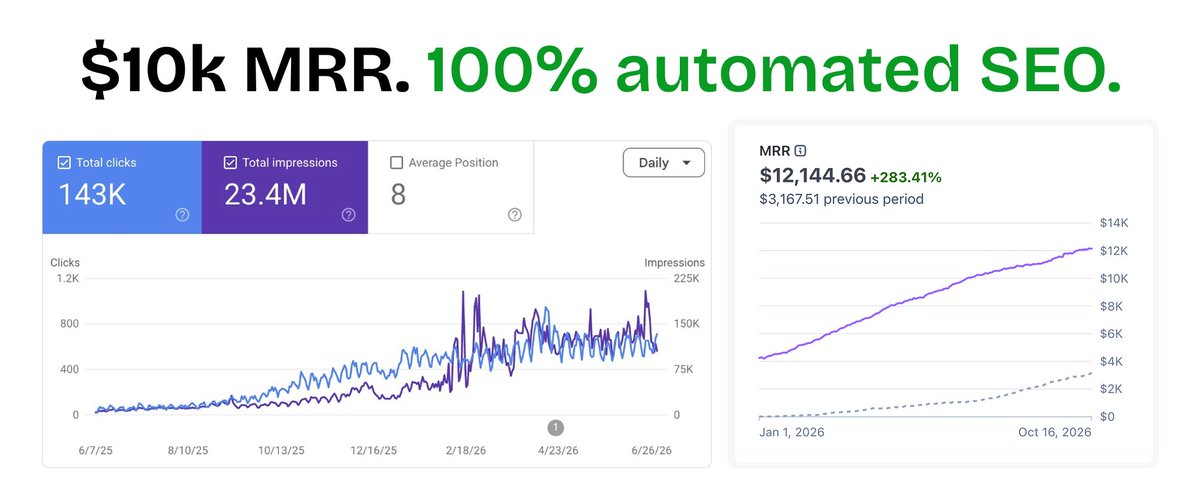
  • Kourosh says his app Voicy makes $18k/month with $12k MRR, about 90% from SEO, with the SEO fully automated after six months of work and five years of SEO experience. (The newsletter summary also mentioned 25k monthly Google clicks; that figure is not in the article body I read.)
  • He contrasts this with tools that only write “SEO-optimized” copy: his agent finds keywords, writes through a QA loop, then monitors and rewrites until a page performs, including technical fixes.
  • The setup, step by step:
    • Connections: the site and blog, Google Search Console, a SERP API (he recommends dataforseo.com), Linear or another ticket tool, and a screenshot API (screenshotone.com, with 100 free shots a month).
    • Weekly keyword research as a recurring task, filed as Linear tickets with a target keyword and instructions for the writer.
    • A writing skill aimed at readable articles, not just keyword density; do not publish yet.
    • A QA agent that checks 7th-grade reading level, “AI-slop” tells, SEO, invented claims, images, and CTAs, and sends failures back until they pass.
    • Auto-publish, then mark the Linear ticket done—he says he never writes those tickets himself.
    • Weekly audits that open tickets to improve existing URLs, because a page may need to be rewritten many times.
    • Focus on conversions, not just clicks: connect analytics (he recommends PostHog) and steer research and audits toward pages that actually win customers.
  • He is open that articles also grow his following, and that RomeoSEO.com is this agent packaged as a product. He says to give the system about three months.
From the wire
Kourosh Ghaffari@BuildingWaves

I reached $12k MRR & 25k monthly clicks from Google. 100% Automated. Steal this for yourself and go have some fun❤️

$12k/month with Agentic SEO. Steal it, get Google/AI clicks, make money.

What a marketing engineer should build first

Notes
  • Cody’s post is a map of what a “marketing engineer” should actually stand up with a coding agent, not a vague brief.
  • First, the access the agent needs: a data pipeline and warehouse, a cloud server, media storage, Postgres for agents, cron, application auth, shareable links, a git remote for multiplayer work, and an API gateway for tools such as “Nano banana,” Apollo IO, Seedance, and Apify.
  • Then the workstreams he lists:
    • Paid ads on Google, Facebook, and LinkedIn.
    • SEO, including traditional SEO, AI search, and link building.
    • Cold outbound, including cold email.
  • The tone is blunt: if a marketing engineer doesn’t know what to build first, this is the list.
From the wire
Cody Schneider@codyschneider

if your "marketing engineer" doesn't know what to build first please for the love of god fire them because they're fleecing you or send them this so I don't have an aneurysm everything below is just agents, agents are just code with a thinking loop, connected to a live data

A three-hour go-to-market draft, in the YC style

Notes
  • Finn describes a method he says you learn at Y Combinator: compress a month of go-to-market research into about three hours, without asking Claude to “research the market” in the abstract.
  • Instead, feed it a pile of primary material:
    • 30+ fully indexed competitor sites
    • 10+ earnings-call transcripts from the biggest incumbents
    • 100 customer reviews
    • 10+ Reddit threads of complaints, if you can find them
  • Then ask: what does every successful player understand that customers never say out loud?
  • Fifteen minutes later, he says, you should have blind spots, the consensus, and ideas relevant to customers that nobody is talking about.
  • Next, have Claude attack the idea like a skeptical investor: the strongest version of the argument, and where it still breaks.
  • He mentions tools like Origami for building customer lists to target.
From the wire
Finn Mallery@fin465

theres a method you learn in YCombinator to compress a month of GTM research into 3 hours. you dont ask Claude to “research the market.” instead you feed it: 30+ competitor fully indexed websites 10+ earnings call transcripts (biggest incumbents) 100 customer reviews 10+

Founder content is a system, not a vibe

Notes
  • Anson’s playbook has three parts. The article I read develops the first two in depth: raw material, then six reusable formats. (He also says he will show how to get more mileage from posts that do well.)
  • Raw material, the things only you have:
    • Your numbers, even if they feel small.
    • Your scars—the failures.
    • Your build log. He points at @levelsio, whose account is essentially a public build log, including a June 2014 post at the moment Nomad List started.
  • The six formats, each with a real example and a why:
    • The build log (the entry price is zero if you’re already building; people invest in unfinished things).
    • The documented failure (every founder has at least one).
    • The value post (the entry price is recent, specific experience).
    • He also covers receipts (proof of a win for strangers who don’t know you), a format that works when a detail creates a gap in the story—he notes that “a kid hitting $1M between AP classes” travels when a generic $1M announcement would not—and the milestone chapter, which is more expensive because it needs a story people already follow. A milestone quotes your own earlier post (he cites Marc’s launch tweet from December 2022) so the journey is sitting in the thread. Marc, he says, took eight months to reach 1,000 followers.
  • His advice: start with the two formats that fit you now. If you’re building, start the build log; if you have a scar, write the failure post.

I read the article through the formats and the closing advice. Some later examples are condensed rather than quoted at full length.

From the wire
Anson Lin@ansonlin
founder content is a system [full playbook]

Startups, careers and investing

Why we’re building Muse

Notes
  • Wang’s essay starts from a simple observation: most people never say what they want, even though they want constantly—more time with family, a bakery, an app, a little calm.
    • Unspoken wants die in paperwork, not-knowing-where-to-start, and phone calls never made. He calls each unrealized want “a quiet tragedy of human potential.”
  • Muse is meant to be a “second mind” or general manager: hear the half-sentence, help fill in the blanks, make a plan, send the email, make the call, find funding, keep a schedule, and clear what it can until only the human wanting is left.
  • He is explicit that this is not a genie, and that nobody knows what people will ask for once everyone can start from a written-down dream.
    • Until now the world has been shaped by the few fanatics who figured out how to make their wants real. Muse is a bet on switching that agency on for many more people.
From the wire
Alexandr Wang@alexandr_wang

Here’s to the wanting. Here’s to the dreaming. Here’s to everyone.

Why We're Building Muse

The New Valley: Good businesses that may not be venture-backable

Notes
  • Nikunj names “the new valley”: AI companies at about $5–25M ARR that are real businesses—good customers, good margins, good founders—but may not be venture-backable, because so many competitors are doing the same thing.
  • The committee scene he describes: revenue comes up fast, the space looks impressive, the founder is legible, and then someone asks what is truly unique. The “dreaded pause.” He credits Michael Grinich with a similar point: niche AI-enablement companies may not fit the venture model.
  • AI made idea-to-revenue fast, so viral “zero to X” charts don’t tell you much, and copycats show up in the next accelerator batch. The later-stage question now arrives at seed: is there a path to multiple lines of revenue, or a primary product large enough for hundreds of millions? And you have to decide on 6–12 months of data.
  • He contrasts two historical winning types—hype-driven land grab vs. measured, loyalty-and-profit companies—and says every seed is now priced as if it were on the fast path, even though most will be slow, and nobody knows which is which.
  • Carta, as he cites it: only 15.4% of Q1 2022 seed companies reached Series A within two years, vs. 30.6% for the 2018 cohort. He thinks the squeeze will get worse.
  • Paths he lists for companies stuck in the middle:
    • A second act that can actually get to hundreds of millions.
    • M&A, often for talent rather than revenue (his example: four years to $8M, then an incumbent that wants the people).
    • Stay, build a valuable company, maybe buy back stock, use alternative capital.
    • “Seed-strap”: raise a little, get profitable, keep 80%+, and tell investors you won’t raise again—the only honest people in the story, in his phrasing.
  • Dividend-like or SBIR-like vehicles keep getting proposed (he mentions indie.vc and Earnest Capital); founders liked them, LPs generally did not, because a capped dividend doesn’t fit their buckets. He doesn’t expect a systemic capital fix: venture is an outlier business, and founders knew that when they took the money.
From the wire
Nikunj Kothari@nikunj
the new valley

Josh Kushner’s first formal letter to Thrive investors

Notes
  • This bookmark is a reprint of Josh Kushner’s first formal letter to Thrive Capital investors. He wrote it because there would be no Investor Day this year. The introducer notes Thrive as a $65 billion firm.
  • Our Strategy: opportunistic across stage, sector, and geography, but concentrated in a small number of people and ideas; first principles about what founders need; a belief that a few companies create most of the value and that real partnership takes time and context.
    • Scale has changed; the strategy, he says, has not. “Today, Thrive manages more than $65 billion, more than half of which is driven by investment gains.” AUM, he adds, is not the point.
  • Our Perspective: he calls artificial intelligence the most important technology paradigm of our lifetimes, and says Thrive now organizes opportunities across four categories, one of which he names “Assets Counterpositioned to Transformation,” the work of Thrive Eternal.
  • Later sections cover Our Work, Our Performance, and Our Team.
    • On performance, he writes that over the last 12 months Thrive generated more than $1 billion of liquidity, and that they see a path to more.
  • Our Commitment, as he lists it: keep thinking independently; stay ambitious; stay concentrated, because quality is scarce; support founders in exciting and difficult moments; be disciplined when others are euphoric and convicted when others are afraid; earn trust every day.

I read the letter’s opening strategy and perspective, the AUM and liquidity figures, and the closing commitments. Some middle sections (work, team, and the full four-category map) are summarized from their headings and the passages around them rather than quoted at full length.

From the wire
JUNK BOND ANALYST@junkbondanalyst

Josh Kushner wrote his first-ever formal letter to backers of his $65 billion investment firm, Thrive. The letter is an opportunity to understand what Thrive is seeing real-time, and to better understand how Thrive is applying its strategy to this current moment. Letter to

Twelve-factor companies, when taste is the bottleneck

Notes
  • Jeff Huber, riffing on 12-factor apps and 12-factor agents, proposes 12-factor companies for a world where execution is increasingly cheap and the scarce thing is human taste and judgment. The old firm bundled labor and coordination; the new one bundles context and authority. It’s a living document.
  • Data vs. compute: (1) Own your context—don’t use tools that hoard it; write down tacit knowledge so the org is legible to humans and agents. (2) Rent your intelligence, and keep the ability to swap models so you don’t lose pricing power.
  • Build vs. buy: (3) Build your tools, because software is cheaper and your stack is part of your context. (4) Buy infrastructure (databases, training infra, operating systems) so you can move faster.
  • Hiring: (5) For a new task, try teaching an agent before hiring a person. (6) Keep teams small and extremely high-taste, because taste is now the bottleneck.
  • Learning: (7) Default to internal openness; silos are especially bad for agents. (8) Design the company as a compounding learning machine and drive cycle time down.
  • Process: (9) Write rubrics and scorecards for critical work, and iterate the rubric itself. (10) Don’t only hand agents tasks—build proactive background agents with real organizational context.
  • Task learning: (11) Store and learn from production traces, not telemetry “just in case.” (12) Encode expertise by spotting patterns of failure and interviewing the humans who know how to fix them.
  • Bonus (13): think before you add AI; thought and taste remain the advantage. He thanks Dex Horvath (12-factor agents) for a draft read, and points to “The Quick shall inherit the Earth” for more theory.
From the wire
Jeff Huber@jeffreyhuber

Career advice in the age of AI

Notes
  • Phil Chen has worked at a startup, Helm AI, Scale AI, OpenAI, and Google, and now hires for an agent-native company. His premise: models get better at anything you can write a loss function for, and school is mostly loss functions, so the valuable work is what can’t be graded inside a training run.
  • 1. Focus on resources that are truly limited: time, relationships, and reputation—not cash, which is easier to get than it used to be.
    • He took Scale over higher-paying quant offers and says the network and exposure mattered more, including later paths to DeepMind and OpenAI and a community of Scale founders.
  • 2. Learn to find problems, not only solve them. In an agent-native hiring loop, LeetCode and even system design felt uncorrelated with the job; they interview for reading an environment, picking a problem, and executing under its constraints. Candidates still differ a lot in how much time and tokens they need.
  • 3. Work on the most ambitious form of a problem (a “bitter lesson” for careers and companies). Choose a company that is actually attacking that form, and a role on the frontier of it.
  • 4. Sprint the last mile. He cites Alfred Lin: the last 10% is 90% of the work and of the reward. Median output is what an agent can do with a sloppy prompt; value is perspective and finish. Sometimes it’s better to restart on the next model than to keep patching.
  • 5. Increase both xG (being in a position to see chances) and efficiency (converting them). He turned down Anthropic and Cursor twice to work on inference and training, first at DeepMind and then at OpenAI; he still thinks those were high-xG offers. He wouldn’t bet on ASI replacing problem selection and capital allocation. Don’t over-anchor on an early-stage product (Anthropic’s first demo, for him, was a Slackbot worse than ChatGPT).
  • 6. You can break into research now: distill intuitions into evaluations, use public optimization leaderboards, and spend academic compute credits. He treats “researcher” as a mentality—curiosity, infrastructure, system-level debugging, and explaining why a result deserves more compute—not only a job title.
From the wire
Phil Chen@philhchen
Career advice in the age of AI

The one hire almost every startup wants

Notes
  • Michael quotes a well-known founder (unnamed): right now, and at probably every startup they know, they are really only hiring one kind of person.
  • That person, in the quote, is a decent designer, a decent frontend engineer, and someone willing to run a lot of product experiments.
  • He asks whether people agree, and who they think that founder is.
From the wire
Michael@michael_chomsky

Recently heard a very well-known founder say: “Right now, me and probably every single startup I know is really only hiring for one type of person, and that person is a combination of a decent designer, decent frontend engineer, and someone who is willing to take a lot of product

Make a personalized demo, don’t compete on grades

Notes
  • Gabriel’s job-hunting advice: don’t compete with hundreds of applicants on grades or school names—none of them will be making a personalized demo.
  • He says that demo got him all of his interviews, including OpenAI, more than two years before moving to San Francisco.
  • The post includes a video of the demo.

I outlined the post’s advice. I did not watch the attached demo video.

From the wire
gabriel@gabriel1

never compete when applying for jobs, there are hundreds of applicants with better grades and universities than you. but none of them will be making a personalized demo i used this demo to get all my interviews like openai over two years ago before moving to sf

Video preview
Video — play on X

How he won $700,000 in scholarships—without treating class as the fastest path

Notes
  • Krishiv won $700,000 in scholarships to top Canadian programs (he names Waterloo Engineering and U of T EngSci) while skipping 200+ classes in Grade 12. The post is aimed at high-school builders, especially in Ontario, who want time to build without tanking grades.
  • Disclaimers: he went to a competitive public school with an enriched program; this is written for students with agency; what worked in his context may not transfer one-for-one.
  • Two uncomfortable beliefs he wants internalized:
    • Going to class every day is not necessarily the fastest way to learn that class’s content.
    • The right resources, AI, and discipline can often beat a lecture.
  • The goal, as he frames it, is to free the 40+ hours a week that class and routine studying take, and to become obsessed with return on time—not to skip class for its own sake. The first skipped day felt like falling behind; later it felt like moving toward the life he wanted.
  • On speed: if a topic takes two class periods, he says you can often cover and start mastering it with a short curriculum-specific video, a few minutes of clarifying questions to ChatGPT, and practice questions.
  • Resources should be specific to your curriculum.
    • For Ontario math, he says JensenMath was enough to master Advanced Functions, Calculus and Vectors, and the rest, including practice tests some teachers seem to echo.
    • For Grade 11/12 sciences, he found teachers leaning on Nelson textbooks; he got 99% in Grade 12 Physics mostly by reading the textbook, but he still went in for physical demonstrations.
    • If there’s a textbook, read the PDF and ask ChatGPT on the side.
  • English, he says, is different and often blamed on a teacher’s taste. His tactic: finish essays early, send a snippet or talk to the teacher, and ask what would raise the grade—showing effort, and making it harder to ignore the requested improvements.
  • He closes by saying the point is hours you can put into building, writing, friends, or exercise, and that entering high school his days were misaligned with the life he wanted.
From the wire
Krishiv@KrishivThakuria

I won $700,000 in scholarships to Canada’s top university programs (Waterloo Eng, UofT EngSci, etc) but skipped 200+ classes in Gr.12 If you're a high schooler like I was who wants to build 24/7 but don't want to disappoint your parents with bad grades, here's what I did

Inner work and relationships

A meditation for mapping anxiety in the body

Notes
  • Vacha offers a step-by-step meditation for turning “anxiety” from one shapeless blob into a map of where different anxieties live, how they cluster, and what each is trying to do. He says the same method works for other emotions.
  • The method, as he lists it:
    • Sit upright as in a formal meditation, then bring to mind something that reliably provokes anxiety.
    • Experiment with different kinds of anxious thought: about the past, the present, and the future.
    • Notice where each one shows up in the body, and whether sensations cluster into categories.
    • Later steps ask you to see that the sensation and the action it seems to demand are not inherently bound, and to look at how the same impulse could be re-channeled into something nourishing.
  • What can come out of it, he says, is a detailed psychosomatic map of your anxiety.
  • He is quoting another post (which I was able to load) as the prompt for this method.
From the wire
Vacha@TVachaW

To overcome anxiety, it can be very useful to create quite a detailed psychosomatic map of how it functions. The method is something like this: 1. Start by sitting down in a comfortable upright position as you would for a formal meditation 2. Try to think about something that x.com/TVachaW/status…

Quoted post
Vacha@TVachaW

I felt like I connected to the spirit of dopamine in my meditation today. Or, I should say, the spirit of dopamine in its unawakened form. He appeared to me at once like a worn out crack addict and enterprising crack dealer. But instead of crack, he dealt in tranquilizers. x.com/TVachaW/status…

“Fundamental OKness” is not the goal of Buddhist practice

Notes
  • Vacha grants that meditation can produce a sense of fundamental OKness while leaving the rest of your motivational system mostly untouched.
    • You can even use that ease to keep chasing default consumerist or materialist goals, with less “grabbiness,” and that can still make life happier.
  • He says it is a serious mistake to treat that as the fundamental goal of Buddhadharma, and a further kind of hubris to treat it as a more advanced view than what the tradition is aiming at—something he associates with 21st-century Bay Area culture.
  • Long-term practitioners who spent decades in full-time practice, he writes, report deeper layers: intent, motivation, desire, values, ethics, and behavior actually transforming.
    • It is not “California values, just less grabby.”
    • The insights are supposed to change what seems desirable, how you treat others, what identity is, and even how you see life and death.
  • He points at the Buddha not returning to the palace to consume experiences more calmly, and he is pushing back on a quoted post about OKness as the goal.
From the wire
Vacha@TVachaW

Meditation absolutely can give you a sense of fundamental OKness, whilst the rest of your behavioural-motivation system goes more or less untouched. You absolutely can use it to continue pursuing our society’s default consumerist-hedonist-materialist goals with more ease and x.com/corbindreams/s…

Quoted post
corbin@corbindreams

pop buddhism will say desire is the root of suffering and meditator nerds will say no actually it’s more precise to say tanha is the cause of dukkha but it’s really more like “it turns out that if you look really closely (helpful to have some amount of concentration and

A board of posts on “Metta Productivity”

Notes
  • Pranab opens a thread of saved posts about bringing his practice into his work, after 18 months of exploring expanded awareness, IFS, and AoA.
  • He provisionally calls the feeling “Metta Productivity”: work powered by “cleaner fuel.”
  • This post is the intro to that “vibe board,” not the collected posts themselves.

This post is a thread opener. I outlined the introduction; I did not collect or outline every post in the thread.

From the wire
Pranab@nopranablem

🧵For the last 18m, I've explored what it means to “bring my practice to work.” Expanded awareness, IFS, AoA -- how does work feel when it’s powered by cleaner fuel? Here’s a vibe board of tweets I’ve saved that point to the thing I'm provisionally calling Metta Productivity

Fifteen steps for setting a boundary

Notes
  • Anita’s process for setting a boundary, as she lists it:
    • 1–2. Walk or stand up, alone, and start a voice memo.
    • 3–5. Talk until the real issue surfaces, feel and move whatever emotion comes up, and repeat that loop.
    • 6–10. Ask, “If I were to open my heart to [this person], I would feel…,” move the emotion, and keep asking until it shifts to “when I open my heart… I feel…”
    • 11–14. With an open heart, privately say the truest thing that wants to be said, let more emotion through, and iterate on the message until it feels clean, true, and open-hearted.
    • 15. Deliver it, out loud or by text.
  • The aim is a message that feels clean rather than a boundary delivered from leftover heat. She points at later posts for the “feel/move the emotion” part.
From the wire
anita@neats29

how I set boundaries with someone: 1. either go on a walk or stand up in my room (on my own) 2. turn on my voice memo 3. do a verbal vomit of what's happening until I land on the particular thing that I feel resonance about. eg: "I feel like [person] has an image of me and I

Federer’s answer: A day he loved, repeated for 20 years

Notes
  • Josh shares Steve Kerr’s story of Roger Federer talking to the Warriors in Shanghai in 2017, during a China trip, while Federer was there for the Masters.
  • Draymond Green asked how Federer was still winning majors 20 years after the first one. People expected “I work harder than everybody.”
  • Federer’s answer was a day he loved:
    • Breakfast for his kids, then the school drop-off.
    • About two hours of practice, in a routine that didn’t destroy his body but got the work done.
    • Lunch with his wife; dinner together; ask the kids about school; put them to bed; and lie down thinking, “that was just a great day.” He said he’d been doing that for 20 years.
  • Kerr’s gloss, as quoted: sustained success wasn’t outworking everyone. It was loving the work, the family, and the life around them—perspective, joy, ritual, and not banging your head against the wall.
From the wire
Josh Chambers@JoshChambers

Steve Kerr says Roger Federer taught his Warriors team the secret to sustained success wasn’t outworking everyone, it was building a life around your craft you never want to escape from “I’ll tell you a great story about Roger Federer. We were playing in China with the Warriors

Video preview
Video — play on X

Eight conversations to have before marriage

Notes
  • Kait lists eight conversations to have before marriage:
    • 1. Sexual intimacy and needs.
    • 2. Priorities: what marriage means, and where it sits on each person’s list.
    • 3. Decision-making: who has the final word when you disagree.
    • 4. Money and spending habits.
    • 5. Values.
    • 6. Household duties.
    • 7. Red lines: things you could not come back from, which she says requires self-awareness.
    • 8. Conflict, communication, and resolution—the standards and boundaries that protect both people.
  • Her line: “Unspoken expectations become future resentments.” Talk about the uncomfortable things before you find out you’re incompatible.
  • She quotes a note that sexual expectations need to be established before marriage, or “you are just rolling the dice.”
From the wire
Kait Willett@KaitWillett

Conversations to have before marriage: 1. Sexual intimacy and needs. This should be obvious 2. Priorities. What does marriage mean to each of you and where does it fall on your list 3. Decision making. Who has the final word on things when you disagree? 4. Money and spending x.com/JThiel/status/…

Quoted post
Justin Thiel@JThiel

@dovidfeldman IMPORTANT NOTE: Make sure the woman actually cares about sex and that the consensual dynamic of sexual expectations is established BEFORE getting married, or you are just rolling the dice with your future.

Human 3.0, a map of personal growth

Notes
  • Dan Koe’s “Human 3.0” is a map of personal growth he presents as a way to maximize potential (the title also calls it a map to the “top 1%”). He says many models already exist; this one is his foundation.
  • The structure has five layers:
    • Four quadrants: Mind, Body, Spirit, and Vocation.
    • Three levels in each: Conformist, Individualist, and Synthesist.
    • Three phases at each level: Dissonance, Uncertainty, and Discovery. Growth, in his account, comes from solving the problems each stage brings.
    • Traits associated with those positions, and “Channels” you can enter by a stated process (he also discusses “glitches”).
    • Archetypes and Metatypes that describe a person’s pattern across the map.
  • He includes a scoring method: one point for each Level 1 trait, two for Level 2, three for Level 3. A worked example lands at “Human 2.0” (in the example, the Mind is near a construct-level awareness, while the Body still has poor habits but occasional confidence).
  • A closing section describes a “3.0 lifestyle” built from living on the later levels rather than collecting the diagram for its own sake.

I outlined the model’s named structure, the scoring rule, and the closing lifestyle section. Some of the longer worked examples and channel details are condensed.

From the wire
DAN KOE@thedankoe
Human 3.0 – A Map To Reach The Top 1%

Friends in SF

A welcome to Aila in San Francisco

Notes
  • Diane McCormack welcomes Aila to San Francisco, thanks Cyrus for the introduction, and tags women in the city she thinks Aila should meet.
  • She is quoting Aila’s introduction post (which also appears later in this issue).
From the wire
Diane E. McCormack@dianeemccormack

SF is lucky to have you @mostlyaila !! Thanks for the intro to this gem @cyrusnewday 🫶🏽 Some amazing ladies you need to meet @peggy_wang @gracegongGG @samanthajeanneb @lilyyang169 @Simar_Boparai_ and ofc you already know @gargi_kand !! x.com/mostlyaila/sta…

Quoted post
aila@mostlyaila

hiii X, i’m aila! - moved from Toronto to SF and make frequent guest appearances in NYC - revived the IG i abandoned at 100k+. shoutout to the 65k survivors - sidequestmaxxing - here to bring taste + intentionality into

A request to welcome Aila to San Francisco

Notes
  • Cyrus asks mutuals to welcome his girlfriend Aila after her move to San Francisco, and to point her toward events and community roles.
  • He is quoting her introduction post.
From the wire
Cyrus@cyrusnewday

hey twitter mutuals my gf is moving to SF wants to bring taste+class to the scene. she's looking for events/community roles! please be nice 🥰 fun fact she has a 99.98th percentile iq 👈😉👈 x.com/mostlyaila/sta…

Quoted post
aila@mostlyaila

hiii X, i’m aila! - moved from Toronto to SF and make frequent guest appearances in NYC - revived the IG i abandoned at 100k+. shoutout to the 65k survivors - sidequestmaxxing - here to bring taste + intentionality into

Aila introduces herself after the move from Toronto

Notes
  • Aila introduces herself after moving from Toronto to San Francisco, with frequent trips to New York.
  • She wants to bring taste and intention to the city’s events scene, and asks people to share their favorite spots.
From the wire
aila@mostlyaila

hiii X, i’m aila! - moved from Toronto to SF and make frequent guest appearances in NYC - revived the IG i abandoned at 100k+. shoutout to the 65k survivors - sidequestmaxxing - here to bring taste + intentionality into